35. Movement After 55
Ayurveda recommends exercise (vyayama) to half one's capacity (ardha shakti) — until light sweat appears on the forehead, nose and armpits and breathing quickens but stays comfortable. Charaka cautions that the elderly and those with Vata disorders should exercise gently. Modern guidance agrees in spirit and adds specifics: the World Health Organization recommends 150–300 minutes of moderate activity a week for adults, with muscle-strengthening on two or more days, and for those over 65 multicomponent activities — balance, coordination and strength — on three or more days a week to prevent falls [1].
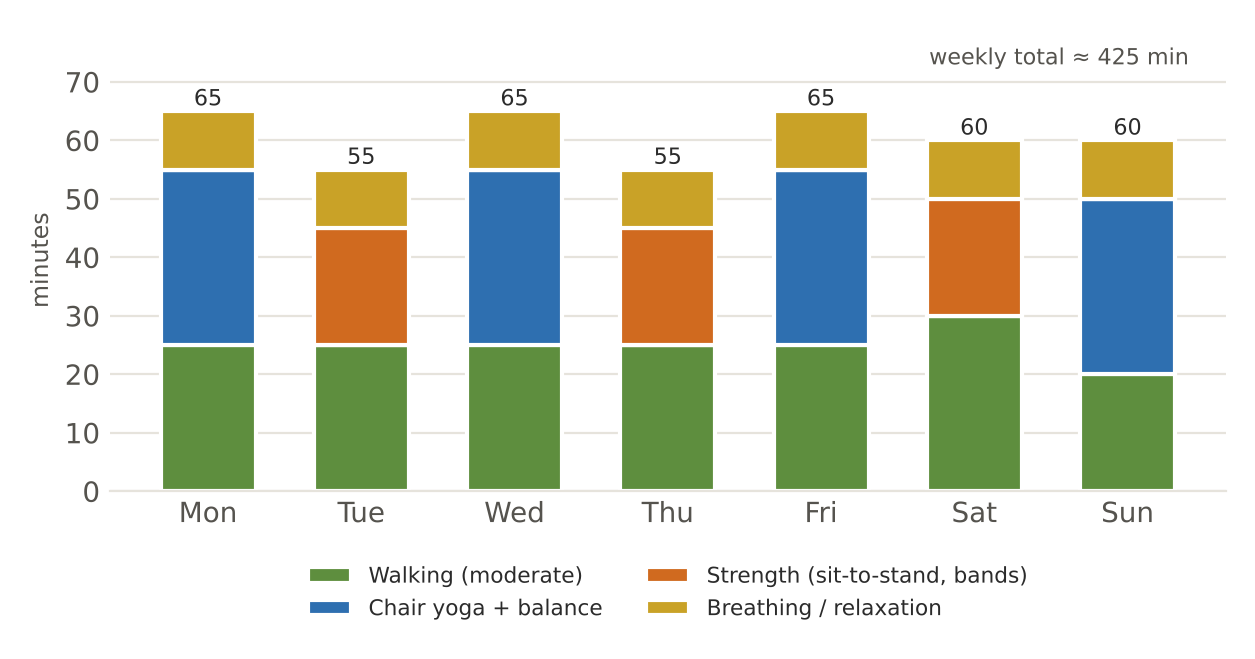
Figure. A balanced week of movement for guests over 55 (minutes per day)
Gentle chair-and-standing yoga sequence (30 minutes)
Chair-based yoga programmes have been studied in older adults with improvements in mobility, function and confidence, including in knee osteoarthritis [5]. The sequence below is led daily at the Centre by an English-speaking yoga trainer (40-minute session, ₹300) and can be practised alone once learned.
| No. | Practice | Position | How | Breaths / reps | Benefit | Caution | |
|---|---|---|---|---|---|---|---|
| 1 | Settling breath | Seated on chair | Feet flat, spine tall; slow belly breaths | 10 breaths | Calms, focuses | — | |
| 2 | Neck rolls (half circles) | Seated | Chin to chest, ear to shoulder side to side — never full backward circles | 5 each way | Neck mobility | Stop if dizzy | |
| 3 | Shoulder rolls | Seated | Lift, back, down | 10 | Upper back, posture | — | |
| 4 | Seated cat–cow | Seated, hands on knees | Arch with inhale, round with exhale | 8 | Spine mobility | Gentle range in osteoporosis | |
| 5 | Seated twist | Seated | Hand to opposite knee, turn gently from the waist | 3 breaths each side | Digestion, spine | Small range after spinal surgery | |
| 6 | Seated side bend | Seated | One arm overhead, lean gently | 3 breaths each side | Rib cage, breathing | — | |
| 7 | Ankle and wrist circles | Seated | Slow circles | 10 each | Joint lubrication | — | |
| 8 | Seated marching | Seated | Lift knees alternately | 20 | Hip strength, circulation | — | |
| 9 | Sit-to-stand | Chair | Stand up and sit down without hands if possible | 5–10 | Leg strength — key for independence | Use hands if needed | |
| 10 | Chair-supported mountain pose (tadasana) | Standing behind chair | Hands on chair back; stand tall; weight even | 5 breaths | Posture, balance | — | |
| 11 | Heel raises | Standing, holding chair | Rise onto toes, lower slowly | 10 | Calf strength, balance | — | |
| 12 | Chair-supported tree pose (vrikshasana) | Standing, holding chair | Sole of one foot on the other ankle or calf | 3–5 breaths each side | Balance | Keep a hand on the chair | |
| 13 | Supported warrior (virabhadrasana) | Standing, chair at side | Small step forward, bend front knee slightly | 3 breaths each side | Leg strength | Short stance | |
| 14 | Walking practice | Hall or garden | Heel–toe walking along a line | 2 lengths | Gait, balance | Near a wall or rail | |
| 15 | Relaxation (shavasana or seated) | Lying or seated | Body scan, slow breath | 3–5 min | Rest, calm | Use a chair if lying down is difficult |
Stop and seek help if
|