4. The Twenty Qualities (Gurvadi Gunas)
Ayurveda describes every substance and every state of the body by ten pairs of opposite qualities. This is its most practical tool: like increases like, and opposites balance. If a guest is dry, constipated and cold (Vata qualities), the kitchen adds their opposites — moist, smooth and warm — through ghee, soups and warm spices.
| Quality | Opposite | Increases | Food examples (first quality) | Food examples (opposite) | |
|---|---|---|---|---|---|
| Heavy (guru) | Light (laghu) | Kapha / Vata | Urad, paneer, sweets, cheese, wheat | Moong, puffed rice, barley, steamed vegetables | |
| Slow (manda) | Sharp (tikshna) | Kapha / Pitta | Milk, rice, banana | Chilli, mustard, garlic, ginger | |
| Cold (shita) | Hot (ushna) | Vata–Kapha / Pitta | Cold water, cucumber, ice cream | Ginger, pepper, sesame, hot soup | |
| Unctuous (snigdha) | Dry (ruksha) | Kapha–Pitta / Vata | Ghee, sesame oil, avocado, coconut | Barley, millets, crackers, popcorn, beans | |
| Smooth (shlakshna) | Rough (khara) | Kapha / Vata | Ghee, milk, okra | Raw vegetables, bran, dry leafy greens | |
| Dense (sandra) | Liquid (drava) | Kapha / Pitta–Kapha | Cheese, nuts, khoya | Soups, juices, buttermilk | |
| Soft (mridu) | Hard (kathina) | Kapha–Pitta / Vata | Khichdi, ripe banana, kheer | Raw nuts, hard rotis, dry toast | |
| Stable (sthira) | Mobile (chala) | Kapha / Vata | Root vegetables, grains | Caffeine, sprouts, raw salads | |
| Subtle (sukshma) | Gross (sthula) | Vata–Pitta / Kapha | Spices, hing, herbal teas | Heavy fried foods, cheese | |
| Clear (vishada) | Slimy (picchila) | Vata–Pitta / Kapha | Water, light vegetables | Okra, curd, urad, taro |
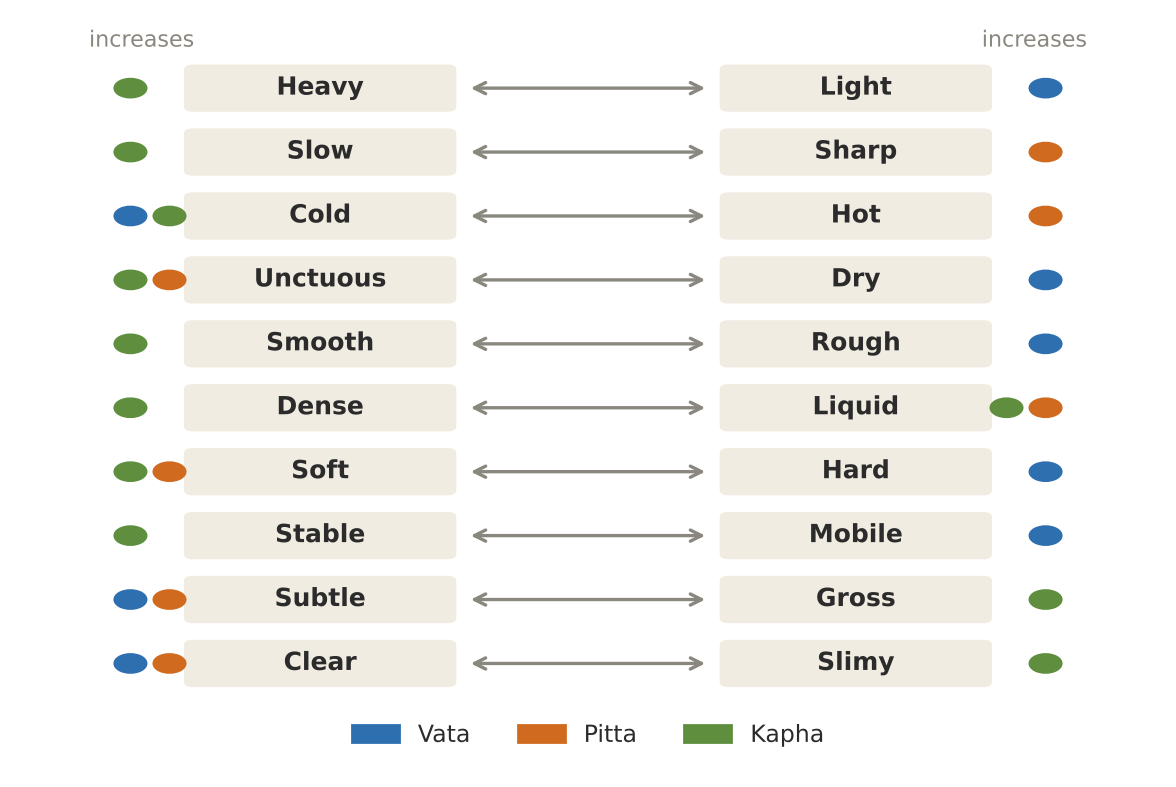
Figure. The ten pairs of qualities, and which dosha each side increases