23. Freshness, Leftovers and Storage
Ayurveda regards food cooked more than about three hours earlier (paryushita) as having lost its vitality, and reheated, stale food as tamasic. Modern food safety agrees for different reasons: bacteria multiply quickly between 5 °C and 60 °C. For older guests, whose immunity is lower, both sets of reasoning point the same way.
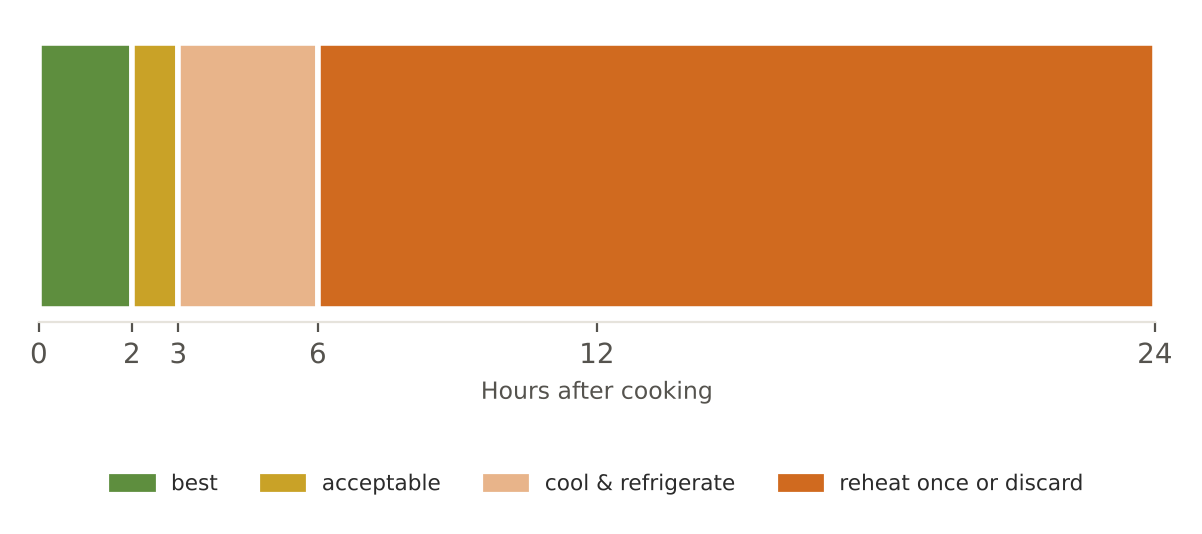
Figure. Freshness timeline — when cooked food is at its best and when it must be discarded
| Food | Best served within | If stored | Never | |
|---|---|---|---|---|
| Dal, sabzi, khichdi | 2 hours of cooking | Cool fast, refrigerate ≤ 5 °C, use within 24 h, reheat once to ≥ 75 °C | Reheat twice; leave out overnight | |
| Cooked rice | 1–2 hours | Cool within 1 h, refrigerate, use within 24 h | Keep warm for hours (Bacillus cereus risk) | |
| Phulka | Immediately | Wrapped in cloth in a casserole up to 2 h | Microwaved dry rotis for elders | |
| Curd | Same day it sets | Refrigerate; use within 2 days | Over-sour curd for Pitta guests | |
| Chutneys (coconut) | Same day | Refrigerate up to 1 day | Coconut chutney held at room temperature in summer | |
| Milk desserts | 4 hours | Refrigerate; serve at room temperature within 24 h | Left out overnight (even the Sharad Purnima kheer tradition is limited to 2 hours) | |
| Batters (idli, dosa) | After fermentation | Refrigerate up to 2 days | Over-fermented, sour batter |