November — Nourish & Build — Diwali, Annakut & Kartik Snan
| Hindu months | Kartik – Margashirsha |
| Ayurvedic season | Sharad → Hemanta (early winter) |
| Haridwar weather | ≈ 12 – 26 °C, crisp mornings, dry air |
| Agni (digestion) | Strong — the 'building' season begins |
| Dosha picture | Pitta settling; Vata rising with dryness and cold |
| Favour | Sweet, sour, salty; unctuous, warm, nourishing; ghee, sesame, milk, jaggery |
| Limit | Dry, cold, light-only food; skipping breakfast; cold drinks |
In season
| Vegetables & greens | Fruit | Pantry & other |
|---|---|---|
| Amla, methi, palak, peas, cauliflower, carrots, radish, sweet potato, singhara, beans, cabbage | Guava, oranges, amla, apple, pomegranate, sitaphal (early) | Fresh jaggery (end), sesame, nuts |
Festivals & observances
| Occasion | Kitchen response |
|---|---|
| Diwali (Kartik Amavasya) | Soft mithai: moong dal halwa (small), kaju–date roll, besan ladoo (soft); a 'sugar-smart' sweet box for diabetic guests. |
| Govardhan Puja / Annakut | 56-dish spirit in a single mixed-vegetable Annakut sabzi with kadhi and rice. |
| Kartik Purnima / Dev Deepawali | Ganga snan in Haridwar; light satvik thali, kheer. |
| Gita Jayanti (late Nov/Dec) | Simple prasad: panchamrit, sheera. |
Kitchen guidance for November
-
Increase portion size slightly and reintroduce parathas, nuts and sesame.
-
Amla every day — November is peak amla; make murabba and chutney for the season.
-
Begin weekly 'oil-massage day' menus with warm soups and khichdi.
-
Diwali: offer small portions of sweets with the meal, never on an empty stomach.
Daily rituals: on waking — Warm cumin–ginger water; at bedtime — Golden milk with nutmeg and ½ tsp ghee.
Seven-day menu — November
Rotate weekly; swap any item for one from 'Further dishes & variations' at the end of this chapter. Lunch always includes rice and phulka; curd/raita is served at lunch only.
| Day | Breakfast 7:30–9:00 | Lunch thali 12:30–2:30 | Evening 4:00 | Dinner 7:00–8:30 |
|---|---|---|---|---|
| Monday | Paneer–methi paratha (soft) · curd | Panchmel dal (light) · Annakut mixed vegetable · Gobhi–matar adraki · rice & phulka · Amla–ginger chutney | Badam–kesar milk | Shakarkandi–gajar–ginger soup · phulka · sweet: Amla murabba (1) |
| Tuesday | Vegetable upma · guava | Masoor–palak · Palak paneer · Gajar–matar–shakarkandi · rice & phulka · Beetroot raita (room temp.) | Amla–ginger tea | Moong khichdi · sweet: Moong dal halwa (30 g) |
| Wednesday | Moong chilla · amla chutney | Methi–moong dal · Aloo–methi · Kaddu khatta-meetha · rice & phulka · Spiced takra | Roasted makhana | Palak–moong soup · phulka · sweet: Gajar halwa (40 g) |
| Thursday | Ragi porridge · dates | Whole moong · Beans thoran · Matar paneer (light) · rice & phulka · Mint–coriander chutney | Stewed guava | Vegetable dalia · sweet: Kaju–date roll |
| Friday | Rice idli · coconut chutney | Toor dal with lauki · Mooli bhurji · Cabbage–peas · rice & phulka · Carrot–amla pickle (fresh) | Sweet-potato chaat | Methi–moong khichdi · sweet: Besan ladoo (soft, small) |
| Saturday | Oats with dates & walnuts · orange | Chana dal–lauki · Annakut mixed vegetable · Gobhi–matar adraki · rice & phulka · Amla–ginger chutney | Til–gud ladoo (mini) | Carrot–ginger soup · rice · sweet: Rice kheer |
| Sunday | Sweet-potato–jaggery porridge | Kadhi (no pakora) · Palak paneer · Gajar–matar–shakarkandi · rice & phulka · Beetroot raita (room temp.) | CCF tea | Lauki–moong dal · phulka · sweet: Sheera (40 g) |
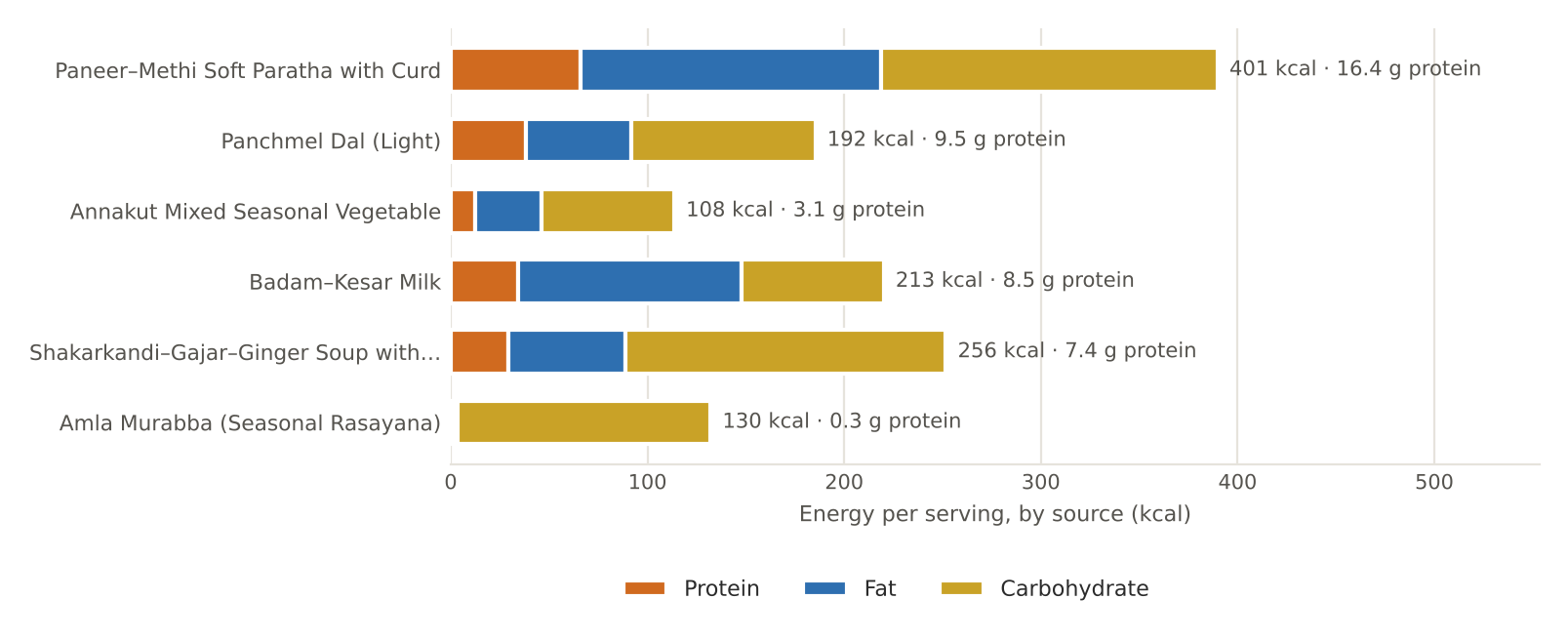
Figure. November's featured recipes — energy per serving by source, with protein
November recipes
Paneer–Methi Soft Paratha with Curd
BREAKFAST · Serves 4 · Portion: 2 parathas + 50 g curd · Rest 20 min · Cook 30 min
Texture: Soft Dosha: Nourishing; Vata-pacifying
| Ingredient | Household measure | Base qty | Café batch ×5 |
|---|---|---|---|
| Whole-wheat flour (atta) | 2 cups | 240 g | 1,200 g |
| Water | ½ cup + 1 tbsp | 140 ml | 700 ml |
| Rock salt (sendha namak) | pinch (dough) | 1 g | 5 g |
| Paneer (cow's milk) | grated | 150 g | 750 g |
| Fenugreek leaves (methi) | 1 cup, finely chopped | 50 g | 250 g |
| Ginger, fresh | 2 tsp grated | 10 g | 50 g |
| Cumin (jeera) | ¼ tsp | 1 g | 5 g |
| Carom (ajwain) | pinch | 0.5 g | 2.5 g |
| Coriander seed / powder | 1 tsp | 2 g | 10 g |
| Rock salt (sendha namak) | ½ tsp (filling) | 2.5 g | 13 g |
| Ghee (cow) | 5 tsp (cooking) | 25 g | 125 g |
| Curd (dahi), plain | ¾ cup + 1 tbsp (to serve) | 200 g | 1,000 g |
Method
1. Knead a soft dough with atta, salt and water; rest 20 minutes.
2. Mix paneer, methi, ginger, spices and salt for the filling.
3. Divide dough and filling into 8; stuff each ball, seal and roll gently to 6 inches.
4. Cook on a medium tawa with ½ tsp ghee per side until golden-spotted.
5. Stack in a cloth to keep soft; serve with room-temperature curd.
| Per serving | Energy 401 kcal | Protein 16.4 g | Fat 17.0 g | Carbs 42.7 g | Fibre 7.0 g | Salt 0.9 g |
Care notes for 55+ guests Roll slightly thick and cook on medium (not high) so parathas stay soft, not crisp. | Ayurvedic note Hemanta's strong agni can digest a heavier breakfast; methi keeps it balanced. |
Variations & further ideas: Gobhi paratha (soft) · Mooli paratha · Matar paratha · Missi roti (soft, small)
Panchmel Dal (Light)
LUNCH · DAL · Serves 4 · Portion: 1 katori (≈180 g) · Soak 1 h · Cook 40 min
Texture: Soft Dosha: Nourishing; hing for Vata
| Ingredient | Household measure | Base qty | Café batch ×5 |
|---|---|---|---|
| Toor / arhar dal | 3 tbsp | 40 g | 200 g |
| Chana dal | 2 tbsp | 30 g | 150 g |
| Moong dal, yellow split | 3 tbsp | 40 g | 200 g |
| Masoor dal (red lentil) | 2 tbsp | 30 g | 150 g |
| Urad dal, split | 1½ tbsp | 20 g | 100 g |
| Water | 3¾ cups | 900 ml | 4,500 ml |
| Turmeric powder | ¼ tsp | 1 g | 5 g |
| Rock salt (sendha namak) | ¾ tsp | 4 g | 20 g |
| Ghee (cow) | 4 tsp | 20 g | 100 g |
| Cumin (jeera) | ½ tsp | 2 g | 10 g |
| Asafoetida (hing) | 2 pinches | 0.4 g | 2 g |
| Ginger, fresh | 2 tsp | 10 g | 50 g |
| Clove | 2 | 0.3 g | 1.5 g |
| Cinnamon | ½-inch | 0.5 g | 2.5 g |
| Bay leaf (tej patta) | 1 | 0.5 g | 2.5 g |
| Kashmiri chilli powder (mild) | ¼ tsp | 1 g | 5 g |
| Tomato | ½ medium (optional) | 60 g | 300 g |
| Coriander leaves | 2 tbsp | 8 g | 40 g |
Method
1. Wash the five dals; soak 1 hour.
2. Pressure-cook with water and turmeric — 5 whistles, then 5 minutes on low.
3. Mash partly.
4. Tadka: ghee, whole spices, cumin, hing, ginger, tomato; chilli off heat.
5. Pour in; add salt; simmer 5 minutes; garnish.
| Per serving | Energy 192 kcal | Protein 9.5 g | Fat 6.0 g | Carbs 23.3 g | Fibre 4.9 g | Salt 1.0 g |
Care notes for 55+ guests Five dals give a broader amino-acid profile; urad and chana make it heavier, so keep to lunch. | Ayurvedic note Rajasthani panchratna made light — Hemanta can digest it. |
Variations & further ideas: Dal makhani (light, no cream, lunch) · Dal tadka · Mixed dal khichdi · Panchmel with lauki
Annakut Mixed Seasonal Vegetable
LUNCH · SABZI · Serves 6 · Portion: 1 katori (≈150 g) · Cook 35 min
Texture: Soft Dosha: Balancing; sweet-sour
| Ingredient | Household measure | Base qty | Café batch ×5 |
|---|---|---|---|
| Potato | 1 small | 100 g | 500 g |
| Sweet potato (shakarkandi) | ½ medium | 100 g | 500 g |
| Carrot | 1 medium | 100 g | 500 g |
| French beans | 10 | 80 g | 400 g |
| Cauliflower | 8 florets | 150 g | 750 g |
| Pumpkin (kaddu) | 1 cup | 150 g | 750 g |
| Green peas, fresh | ½ cup | 80 g | 400 g |
| Spinach (palak) | 1 cup chopped | 80 g | 400 g |
| Ghee (cow) | 4 tsp | 20 g | 100 g |
| Cumin (jeera) | ½ tsp | 2 g | 10 g |
| Asafoetida (hing) | 1 pinch | 0.3 g | 1.5 g |
| Ginger, fresh | 1 tbsp | 15 g | 75 g |
| Turmeric powder | ¼ tsp | 1 g | 5 g |
| Coriander seed / powder | 2 tsp | 4 g | 20 g |
| Rock salt (sendha namak) | 1 tsp | 5 g | 25 g |
| Water | ⅔ cup | 150 ml | 750 ml |
| Jaggery (gur) | 2 tsp | 10 g | 50 g |
| Dry mango powder (amchur) | ½ tsp | 1 g | 5 g |
| Sattvic garam masala (no onion-garlic) | ¼ tsp | 1 g | 5 g |
| Coriander leaves | 2 tbsp | 8 g | 40 g |
Method
1. Cut all vegetables into 2-cm pieces.
2. Heat ghee; cumin, hing, ginger; add potato, sweet potato, carrot and beans with turmeric, coriander and salt; add water, cover 8 minutes.
3. Add cauliflower, pumpkin and peas; cover 8–10 minutes.
4. Add spinach; cook 3 minutes.
5. Finish with jaggery, amchur, garam masala and coriander.
| Per serving | Energy 108 kcal | Protein 3.1 g | Fat 3.8 g | Carbs 16.8 g | Fibre 3.9 g | Salt 0.8 g |
Care notes for 55+ guests Staggered cooking keeps every vegetable equally soft. | Ayurvedic note Annakut — 'mountain of food' — offered at Govardhan Puja; diversity of vegetables nourishes all tissues. |
Variations & further ideas: Undhiyu (steamed, light) · Mixed-vegetable kootu · Avial · Shukto (Bengali bitter-sweet)
Badam–Kesar Milk
EVENING · DRINK · Serves 4 · Portion: 200 ml · Soak overnight · 15 min
Texture: Smooth Dosha: Vata-pacifying, nourishing
| Ingredient | Household measure | Base qty | Café batch ×5 |
|---|---|---|---|
| Almonds | 30, soaked overnight & peeled | 40 g | 200 g |
| Cow's milk, whole | 3⅓ cups | 800 ml | 4,000 ml |
| Saffron (kesar) | 10 strands | 0.1 g | 0.5 g |
| Green cardamom | ⅛ tsp | 0.5 g | 2.5 g |
| Nutmeg | tiny pinch | 0.1 g | 0.5 g |
| Mishri / sugar | 2 tbsp (or 3 dates) | 25 g | 125 g |
Method
1. Grind almonds with 100 ml milk to a fine paste.
2. Boil the remaining milk; add paste; simmer 6 minutes.
3. Add saffron, cardamom, nutmeg and mishri.
4. Serve warm.
| Per serving | Energy 213 kcal | Protein 8.5 g | Fat 12.6 g | Carbs 18.1 g | Fibre 1.3 g | Salt 0.0 g |
Care notes for 55+ guests Fine grinding means no grit — strain if necessary. | Ayurvedic note Badam with milk is a medhya (brain) and Vata tonic for the elderly. |
Variations & further ideas: Kesar–pista milk · Dates milk · Golden milk · Almond–rice kheer
Shakarkandi–Gajar–Ginger Soup with Soft Phulka
DINNER · Serves 4 · Portion: 250 ml soup + 1 phulka · Cook 35 min
Texture: Pureed soup Dosha: Vata-pacifying, warming
| Ingredient | Household measure | Base qty | Café batch ×5 |
|---|---|---|---|
| Sweet potato (shakarkandi) | 1 medium | 200 g | 1,000 g |
| Carrot | 2 medium | 200 g | 1,000 g |
| Moong dal, yellow split | 3 tbsp | 40 g | 200 g |
| Ginger, fresh | 1 tbsp | 15 g | 75 g |
| Water | 4 cups | 1,000 ml | 5,000 ml |
| Ghee (cow) | 1 tbsp | 15 g | 75 g |
| Cumin (jeera) | ¼ tsp | 1 g | 5 g |
| Black pepper | ½ tsp | 1 g | 5 g |
| Rock salt (sendha namak) | ¾ tsp | 3.5 g | 18 g |
| Lemon juice | 2 tsp | 10 ml | 50 ml |
| Whole-wheat flour (atta) | 1 cup (4 phulkas) | 120 g | 600 g |
| Water | 5 tbsp (dough) | 75 ml | 375 ml |
| Ghee (cow) | ½ tsp per phulka | 8 g | 40 g |
Method
1. Pressure-cook sweet potato, carrot, moong and ginger with 800 ml water — 3 whistles.
2. Blend smooth; thin with remaining water; simmer 3 minutes.
3. Temper with ghee and cumin; add pepper and salt; lemon off heat.
4. Make 4 soft phulkas; brush with ghee.
| Per serving | Energy 256 kcal | Protein 7.4 g | Fat 6.6 g | Carbs 40.7 g | Fibre 7.3 g | Salt 0.9 g |
Care notes for 55+ guests Velvety texture; naturally sweet — no sugar needed. | Ayurvedic note Sweet, warm and unctuous: the three qualities that pacify Vata. |
Variations & further ideas: Carrot–ginger soup · Pumpkin–lentil soup · Beet–carrot soup · Sweet-potato–moong khichdi
Amla Murabba (Seasonal Rasayana)
SWEET · Serves 14 · Portion: 1 amla with 1 tsp syrup · Soak overnight · 2 days
Texture: Soft Dosha: Tridoshic rasayana
| Ingredient | Household measure | Base qty | Café batch ×5 |
|---|---|---|---|
| Amla (Indian gooseberry) | 12–14 large | 500 g | 2,500 g |
| Mishri / sugar | 2 cups | 400 g | 2,000 g |
| Water | ⅔ cup | 150 ml | 750 ml |
| Green cardamom | ¼ tsp | 1 g | 5 g |
| Black pepper | ¼ tsp crushed | 0.5 g | 2.5 g |
| Saffron (kesar) | 5 strands (optional) | 0.1 g | 0.3 g |
Method
1. Wash amla and prick all over with a fork; soak in water overnight.
2. Steam or boil 6–8 minutes until slightly soft but whole; drain.
3. Make syrup with mishri and water; add amla and simmer 15 minutes; rest overnight.
4. Next day boil 10 minutes until the syrup reaches one-string consistency.
5. Add cardamom, pepper and saffron; cool and store in a sterilised glass jar; mature 1 week.
| Per serving | Energy 130 kcal | Protein 0.3 g | Fat 0.2 g | Carbs 32.2 g | Fibre 1.6 g | Salt 0.0 g |
Care notes for 55+ guests One amla a day after breakfast. Diabetic guests: plain steamed amla with rock salt instead. | Ayurvedic note Amalaki is the foremost rasayana (rejuvenative) in Ayurveda — rich in vitamin C. |
Variations & further ideas: Amla candy · Amla chutney with jaggery · Amla–ginger juice · Amla pickle (oil-light)
Signature process & further dishes — November
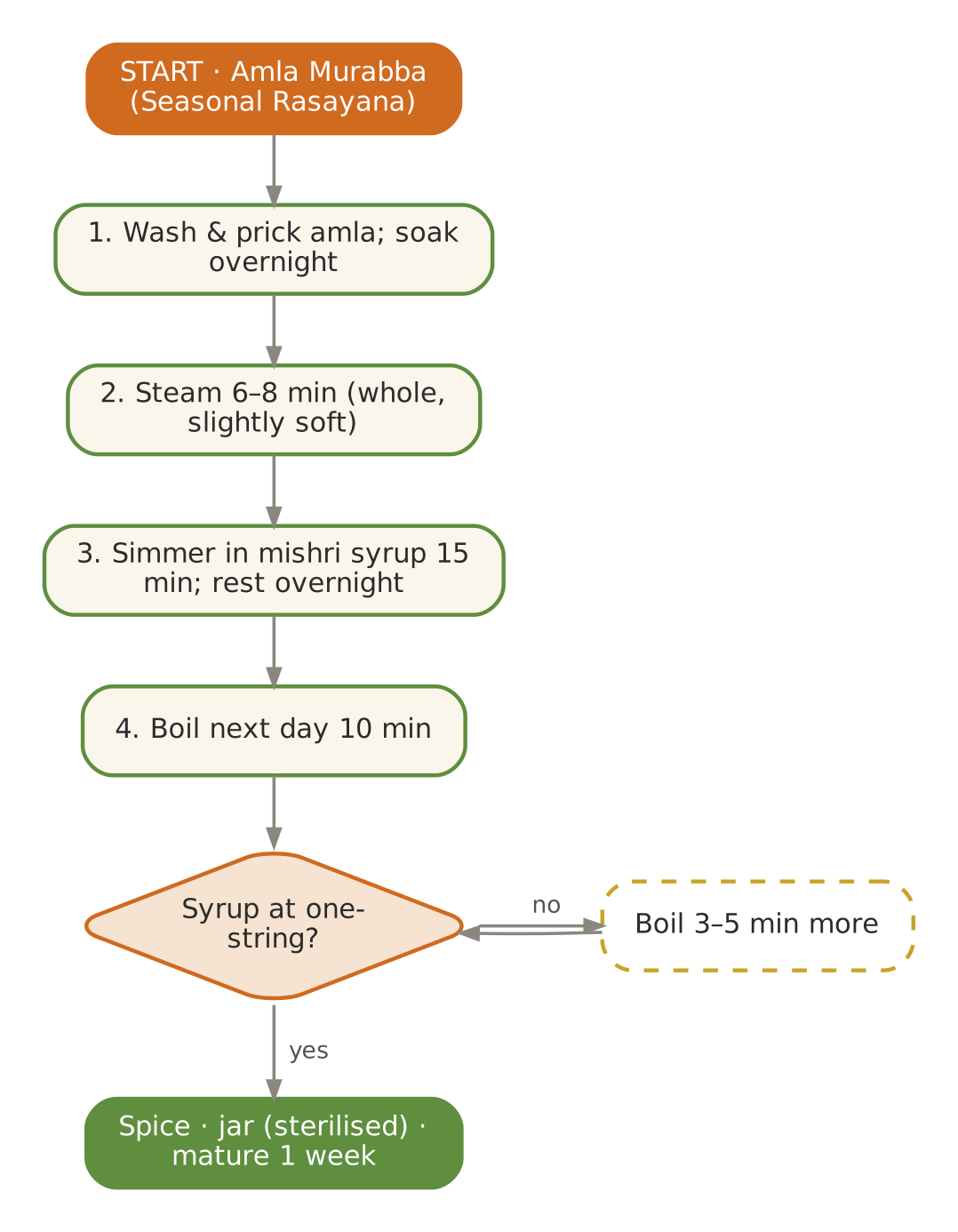 Signature dish: Amla Murabba (Seasonal Rasayana) | Further dishes & variations Breakfast Gobhi paratha (soft) · Matar kachori — baked version · Sooji–vegetable cheela · Bajra raab (savoury drink) · Amla–oats porridge Dals & Saags Dal makhani (light, lunch) · Methi–moong · Palak–chana dal · Kadhi with methi · Mooli dal Sabzis Undhiyu (steamed, light) · Gobhi–aloo · Methi–malai paneer (light) · Singhara–shakarkandi · Shukto Evening Amla–ginger tea · Dry-fruit milk · Guava stewed · Til–gud ladoo · Hot jaggery–ginger water Light Dinners Palak–moong soup · Methi khichdi · Vegetable dalia · Carrot–ginger soup Sweets & Digestives Moong dal halwa · Kaju–date roll · Soft besan ladoo · Amla candy · Saunf–ajwain mukhwas |