January — Warmth, Sesame & Winter Greens
| Hindu months | Paush – Magh |
| Ayurvedic season | Hemanta → Shishira (deep winter) |
| Haridwar weather | ≈ 7 – 19 °C, foggy mornings, dry cold |
| Agni (digestion) | Strongest of the year — nourishing, unctuous food is digested well |
| Dosha picture | Vata aggravated by cold and dryness; Kapha begins to accumulate |
| Favour | Favour sweet, sour and salty; warm, moist, freshly cooked food with ghee and sesame |
| Limit | Cold drinks, raw salads, dry crackers, stale leftovers, long gaps between meals |
In season
| Vegetables & greens | Fruit | Pantry & other |
|---|---|---|
| Sarson, bathua, methi, palak, carrots, peas, radish, turnip, cauliflower, cabbage, sweet potato, fresh turmeric | Guava, oranges/kinnow, amla, ber, apples (hill), papaya | Fresh jaggery, sesame, peanuts, bajra, makki |
Festivals & observances
| Occasion | Kitchen response |
|---|---|
| Lohri (13 Jan) | Til, gur, makhana and roasted peanuts — serve soft til–gud ladoo instead of hard rewri for elders. |
| Makar Sankranti (14 Jan) | Moong–rice khichdi with ghee, til–gud; Haridwar Ganga snan day — expect visitors. |
| Basant Panchami (late Jan / Feb, lunar) | Yellow kesari rice, boondi-free besan barfi (soft). |
Kitchen guidance for January
-
Serve the largest meal at lunch (12:30–1:30 pm); keep dinner light and by 7:30 pm.
-
Include 2–3 tsp ghee across the day; use sesame oil for winter abhyanga-linked menus.
-
Every dish served hot or warm — re-warm curd-based raitas to room temperature only.
-
Leafy saags only well-cooked and blended smooth for guests with dentures.
-
Offer a warm kadha at 4 pm to counter Kapha build-up and fog-season coughs.
Daily rituals: on waking — Warm water with crushed cumin and a slice of ginger (150 ml); at bedtime — Golden milk with turmeric, nutmeg, cardamom & ½ tsp ghee.
Seven-day menu — January
Rotate weekly; swap any item for one from 'Further dishes & variations' at the end of this chapter. Lunch always includes rice and phulka; curd/raita is served at lunch only.
| Day | Breakfast 7:30–9:00 | Lunch thali 12:30–2:30 | Evening 4:00 | Dinner 7:00–8:30 |
|---|---|---|---|---|
| Monday | Methi–moong dal chilla · mint–curd dip · guava | Sarson–palak–bathua saag · Gajar–matar–shakarkandi · Gobhi–matar adraki · rice & phulka · Bathua raita (room temp.) | Haldi–adrak–gud kadha · roasted makhana | Sankranti moong–rice vegetable khichdi · sweet: Til–gud ladoo (1 mini) |
| Tuesday | Bajra–moong soft dalia with ghee · stewed apple | Yellow moong dal tadka · Shalgam bharta · Aloo–methi · rice & phulka · Spiced takra | Til–gud ladoo (mini) · CCF tea | Palak–moong soup · soft phulka · sweet: Gajar halwa (40 g) |
| Wednesday | Gajar–matar upma · amla–ginger tea | Masoor–methi dal · Mooli bhurji with mooli greens · Palak paneer (sattvic) · rice & phulka · Amla–ginger chutney | Stewed guava with cinnamon | Carrot–ginger soup · ghee rice · sweet: Atta panjiri (1 tbsp) |
| Thursday | Steel-cut oats with dates & sesame · kinnow segments | Whole moong dal (soft) · Matar paneer, light gravy · Beans–carrot thoran · rice & phulka · Steamed carrot–beet salad | Badam–kesar milk | Vegetable dalia khichdi · sweet: Date–walnut barfi (1 pc) |
| Friday | Paneer–palak soft paratha · fresh curd | Panchmel dal (light) · Kaddu khatta-meetha · Cabbage–peas with ginger · rice & phulka · Mint–coriander chutney | Roasted shakarkandi chaat | Lauki–moong dal · soft phulka · sweet: Sweet-potato kheer (60 ml) |
| Saturday | Ragi–wheat soft dosa · coconut–coriander chutney | Bathua–moong dal · Gajar–matar–shakarkandi · Gobhi–matar adraki · rice & phulka · Bathua raita (room temp.) | Ginger–cinnamon tea · sesame–walnut mix | Methi–moong khichdi · warm takra · sweet: Sesame-chikki crumble on kheer |
| Sunday | Sweet-potato–jaggery porridge · 5 soaked almonds | Toor dal with lauki · Shalgam bharta · Aloo–methi · rice & phulka · Spiced takra | Orange–ginger infusion · 2 soaked figs | Mixed vegetable soup · jowar phulka · sweet: Moong dal halwa (30 g) |
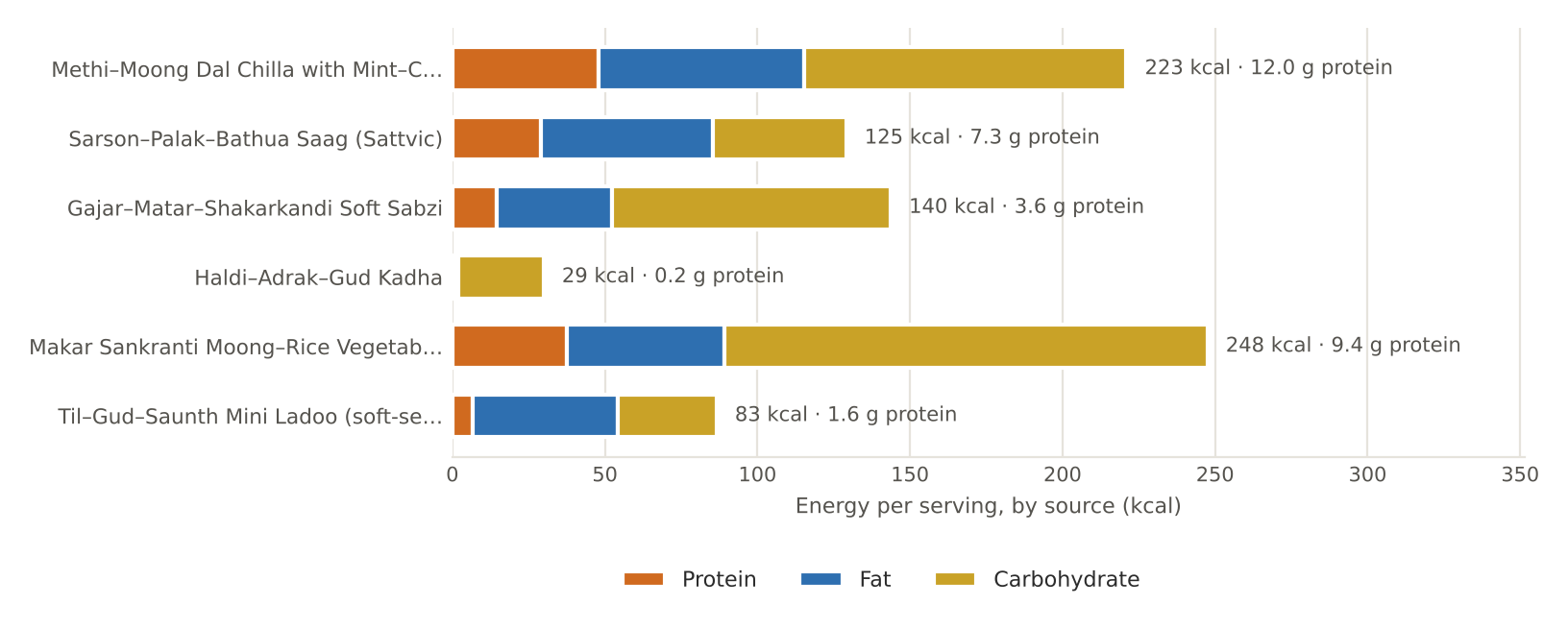
Figure. January's featured recipes — energy per serving by source, with protein
January recipes
Methi–Moong Dal Chilla with Mint–Curd Dip
BREAKFAST · Serves 4 · Portion: 2 chillas (≈120 g) + 2 tbsp dip · Soak 4 h · Cook 25 min
Texture: Soft Dosha: Balances all three; especially Kapha & Vata
| Ingredient | Household measure | Base qty | Café batch ×5 |
|---|---|---|---|
| Moong dal, yellow split | ¾ cup + 1 tbsp, soaked 4 h | 160 g | 800 g |
| Fenugreek leaves (methi) | 1 cup, finely chopped | 40 g | 200 g |
| Ginger, fresh | 1-inch piece, grated | 10 g | 50 g |
| Cumin (jeera) | ½ tsp | 2 g | 10 g |
| Asafoetida (hing) | 1 pinch | 0.3 g | 1.5 g |
| Turmeric powder | ¼ tsp | 1 g | 5 g |
| Rock salt (sendha namak) | ½ tsp (scant) | 3 g | 15 g |
| Water | ½ cup, for grinding | 120 ml | 600 ml |
| Ghee (cow) | 4 tsp (½ tsp per chilla) | 20 g | 100 g |
| Curd (dahi), plain | ¾ cup + 1 tbsp (dip) | 200 g | 1,000 g |
| Mint leaves | ¼ cup leaves (dip) | 10 g | 50 g |
| Cumin (jeera) | ¼ tsp roasted, powdered (dip) | 1 g | 5 g |
Method
1. Rinse the moong dal three times and soak for 4 hours; drain.
2. Grind with ginger, cumin and ½ cup water to a smooth, pourable batter (like dosa batter).
3. Stir in methi, turmeric, hing and salt; rest 10 minutes.
4. Heat a tawa on medium, smear ¼ tsp ghee, pour ½ ladle (≈60 ml) and spread into a 6-inch circle, slightly thick.
5. Cook 2 minutes, drizzle ¼ tsp ghee around the edge, flip and cook 1–1½ minutes. Keep soft — do not crisp.
6. Dip: blend mint with 2 tbsp curd; whisk into remaining curd with roasted cumin and a pinch of salt. Serve at room temperature.
| Per serving | Energy 223 kcal | Protein 12.0 g | Fat 7.5 g | Carbs 26.4 g | Fibre 4.2 g | Salt 0.8 g |
Care notes for 55+ guests Keep chillas soft and slightly thick for easy chewing; chop methi very fine. Curd always at room temperature, never chilled. A good diabetic-friendly, protein-rich breakfast. | Ayurvedic note Moong is the lightest of pulses (laghu) and tridoshic; methi and ginger kindle agni on cold, Kapha-heavy mornings. |
Variations & further ideas: Palak–moong chilla · Besan–oats chilla with grated lauki · Paneer-stuffed moong chilla · Lauki–moong chilla in summer months
Sarson–Palak–Bathua Saag (Sattvic)
LUNCH · SAAG · Serves 4 · Portion: 1 katori (≈150 g) · Prep 20 min · Cook 50 min
Texture: Pureed / smooth Dosha: Reduces Kapha; ghee keeps Vata settled
| Ingredient | Household measure | Base qty | Café batch ×5 |
|---|---|---|---|
| Mustard greens (sarson) | 1 large bunch, leaves & tender stems | 400 g | 2,000 g |
| Spinach (palak) | 1 small bunch | 200 g | 1,000 g |
| Bathua (chenopodium) leaves | 1 cup, packed | 100 g | 500 g |
| Fenugreek leaves (methi) | ¾ cup | 30 g | 150 g |
| Ginger, fresh | 1 tbsp grated | 15 g | 75 g |
| Green chilli (optional, deseeded) | ½ chilli, deseeded (optional) | 3 g | 15 g |
| Water | 1¼ cups | 300 ml | 1,500 ml |
| Rock salt (sendha namak) | ¾ tsp, level | 3.5 g | 18 g |
| Maize flour (makki atta) | 2 tbsp maize flour | 20 g | 100 g |
| Water | ½ cup (to whisk makki) | 120 ml | 600 ml |
| Ghee (cow) | 4 tsp (tempering) | 20 g | 100 g |
| Cumin (jeera) | ½ tsp | 2 g | 10 g |
| Asafoetida (hing) | 1 pinch | 0.3 g | 1.5 g |
| Kashmiri chilli powder (mild) | ¼ tsp Kashmiri chilli | 1 g | 5 g |
Method
1. Wash all greens three times in plenty of water; chop roughly.
2. Pressure-cook greens with ginger, chilli, 1¼ cups water and salt — 3 whistles, then 10 minutes on low (or simmer covered 35 minutes).
3. Cool slightly and blend to a smooth purée (coarse for regular diners, smooth for denture wearers).
4. Whisk makki atta into ½ cup water, stir into the saag and simmer 15 minutes, stirring, until glossy.
5. Tempering: heat ghee, add cumin and hing, then Kashmiri chilli off the heat; pour over the saag.
6. Rest 5 minutes; serve hot with ½ tsp ghee on each katori.
| Per serving | Energy 125 kcal | Protein 7.3 g | Fat 6.3 g | Carbs 10.9 g | Fibre 4.0 g | Salt 0.9 g |
Care notes for 55+ guests Serve with soft wheat phulka made with 25% makki atta rather than all-makki rotis, which are hard to chew. Add 50 g paneer cubes per serving for protein. | Ayurvedic note Sarson is heating (ushna) and sharp; ghee and long, slow cooking soften its sharpness, making it a perfect Shishira Kapha-clearer. |
Variations & further ideas: Saag paneer · Bathua raita (blanched, room temp.) · Palak–methi–moong saag dal · Chaulai (amaranth) saag in monsoon
Gajar–Matar–Shakarkandi Soft Sabzi
LUNCH · SABZI · Serves 4 · Portion: 1 katori (≈130 g) · Prep 15 min · Cook 25 min
Texture: Soft Dosha: Strongly Vata-pacifying (sweet, grounding)
| Ingredient | Household measure | Base qty | Café batch ×5 |
|---|---|---|---|
| Carrot | 2 medium, 1-cm dice | 250 g | 1,250 g |
| Green peas, fresh | 1 cup shelled | 150 g | 750 g |
| Sweet potato (shakarkandi) | 1 medium, 1-cm dice | 200 g | 1,000 g |
| Ghee (cow) | 1 tbsp | 15 g | 75 g |
| Cumin (jeera) | ½ tsp | 2 g | 10 g |
| Asafoetida (hing) | 1 pinch | 0.3 g | 1.5 g |
| Ginger, fresh | 2 tsp grated | 10 g | 50 g |
| Turmeric powder | ¼ tsp | 1 g | 5 g |
| Coriander seed / powder | 1 tsp coriander powder | 2 g | 10 g |
| Rock salt (sendha namak) | ½ tsp | 3 g | 15 g |
| Water | scant ½ cup | 100 ml | 500 ml |
| Lemon juice | 2 tsp | 10 ml | 50 ml |
| Coriander leaves | 2 tbsp chopped | 10 g | 50 g |
Method
1. Heat ghee; add cumin, let it crackle, then hing and ginger for 30 seconds.
2. Add carrot and peas with turmeric, coriander powder and salt; toss 2 minutes.
3. Add water, cover and cook on low 8 minutes.
4. Add sweet potato, cover and cook 8–10 minutes until every piece is fork-tender.
5. Finish with lemon juice and coriander leaves.
| Per serving | Energy 140 kcal | Protein 3.6 g | Fat 4.2 g | Carbs 22.8 g | Fibre 5.6 g | Salt 0.8 g |
Care notes for 55+ guests Dice small and cook covered until a spoon cuts each piece cleanly. Naturally sweet — no added jaggery needed. | Ayurvedic note Sweet, heavy and grounding (madhura, brimhana) — classic Vata medicine for the 55+ years. |
Variations & further ideas: Gajar–matar with paneer · Shakarkandi chaat · Gajar–methi · Beetroot–carrot thoran
Haldi–Adrak–Gud Kadha
EVENING · DRINK · Serves 4 · Portion: 150 ml cup · Cook 15 min
Texture: Thin liquid Dosha: Reduces Kapha & Vata
| Ingredient | Household measure | Base qty | Café batch ×5 |
|---|---|---|---|
| Water | 3 cups | 700 ml | 3,500 ml |
| Ginger, fresh | 1-inch piece, crushed | 15 g | 75 g |
| Turmeric powder | ½ tsp (or 10 g fresh root) | 2 g | 10 g |
| Black pepper | 4–5 peppercorns, crushed | 0.5 g | 2.5 g |
| Cinnamon | 1-inch stick | 1 g | 5 g |
| Tulsi (holy basil) leaves | 8–10 leaves | 3 g | 15 g |
| Jaggery (gur) | 2 tbsp grated | 24 g | 120 g |
| Lemon juice | 2 tsp (optional) | 10 ml | 50 ml |
Method
1. Boil water with ginger, cinnamon, pepper and turmeric.
2. Simmer 10 minutes until reduced to about 600 ml.
3. Add tulsi leaves; simmer 2 minutes.
4. Turn off heat; stir in jaggery until dissolved.
5. Strain; add lemon only once warm. Serve at 60–65 °C.
| Per serving | Energy 29 kcal | Protein 0.2 g | Fat 0.1 g | Carbs 7.0 g | Fibre 0.3 g | Salt 0.0 g |
Care notes for 55+ guests For diabetic guests, omit jaggery and boil in 2 chopped dates or serve unsweetened. | Ayurvedic note Deepana (agni-kindling) and Kapha-clearing; turmeric with pepper improves absorption of curcumin. |
Variations & further ideas: Ajwain–saunf kadha · Tulsi–cinnamon tea · Dalchini–elaichi doodh · Golden milk (bedtime)
Makar Sankranti Moong–Rice Vegetable Khichdi
DINNER · Serves 4 · Portion: 1 bowl (≈300 g) · Soak 20 min · Cook 30 min
Texture: Soft / porridge Dosha: Tridoshic — the house restorative
| Ingredient | Household measure | Base qty | Café batch ×5 |
|---|---|---|---|
| Rice, white basmati (raw) | ½ cup basmati | 100 g | 500 g |
| Moong dal, yellow split | ½ cup | 100 g | 500 g |
| Carrot | 1 small, diced | 80 g | 400 g |
| Green peas, fresh | ⅓ cup | 60 g | 300 g |
| Cauliflower | 6–8 small florets | 80 g | 400 g |
| Ghee (cow) | 4 tsp (2 tadka + 2 serve) | 20 g | 100 g |
| Cumin (jeera) | ½ tsp | 2 g | 10 g |
| Bay leaf (tej patta) | 1 leaf | 0.5 g | 2.5 g |
| Asafoetida (hing) | 1 pinch | 0.3 g | 1.5 g |
| Ginger, fresh | 2 tsp grated | 10 g | 50 g |
| Turmeric powder | ¼ tsp | 1 g | 5 g |
| Black pepper | ¼ tsp crushed | 0.5 g | 2.5 g |
| Rock salt (sendha namak) | ¾ tsp | 4 g | 20 g |
| Water | 3⅓ cups (4 : 1 house ratio) | 800 ml | 4,000 ml |
Method
1. Wash rice and moong together; soak 20 minutes, drain.
2. In a pressure cooker heat 2 tsp ghee; add cumin, bay leaf, hing and ginger.
3. Add vegetables with turmeric; sauté 2 minutes, then the drained grains for 1 minute.
4. Add water, salt and pepper; pressure-cook 4 whistles and allow natural release (10 minutes).
5. Stir well; loosen with 100–200 ml hot water for a porridge-soft texture.
6. Serve each bowl with ½ tsp ghee on top.
| Per serving | Energy 248 kcal | Protein 9.4 g | Fat 5.7 g | Carbs 39.6 g | Fibre 4.6 g | Salt 1.0 g |
Care notes for 55+ guests Porridge-soft, ideal for poor dentition or recovery days. Serve with warm spiced takra rather than cold curd at night. | Ayurvedic note Khichdi is the classic laghu-pachaka (light, easily digested) meal — nourishing without burdening night-time agni. |
Variations & further ideas: Bajra khichdi (lunch only) · Palak khichdi · Dalia khichdi · Samak khichdi on vrat days
Til–Gud–Saunth Mini Ladoo (soft-set)
SWEET · Serves 16 · Portion: 1 mini ladoo (≈15 g) · Cook 20 min
Texture: Soft-chewy Dosha: Vata-pacifying, warming
| Ingredient | Household measure | Base qty | Café batch ×5 |
|---|---|---|---|
| Sesame seeds (til) | 1 cup white til | 120 g | 600 g |
| Jaggery (gur) | ½ cup grated, packed | 100 g | 500 g |
| Almonds | 15 almonds, finely powdered | 20 g | 100 g |
| Dry ginger (saunth) | 1 tsp dry ginger powder | 2 g | 10 g |
| Green cardamom | ¼ tsp powder (4 pods) | 1 g | 5 g |
| Ghee (cow) | 1 tbsp | 15 g | 75 g |
| Water | 1 tbsp | 15 ml | 75 ml |
Method
1. Dry-roast sesame on low 4–5 minutes until it begins to pop and turns pale gold; cool.
2. Coarse-grind half the sesame in a mixer — this makes softer ladoos.
3. Melt ghee, add jaggery and water; stir on low 2–3 minutes until melted and bubbling (a drop in water forms a SOFT ball — do not take to hard crack).
4. Off the heat, mix in all sesame, almond powder, saunth and cardamom.
5. While warm, grease palms with ghee and shape 16 balls of about 15 g.
| Per serving | Energy 83 kcal | Protein 1.6 g | Fat 5.3 g | Carbs 8.1 g | Fibre 1.1 g | Salt 0.0 g |
Care notes for 55+ guests Ground sesame and soft-ball syrup keep these chewable — avoid hard chikki for older guests. Diabetic guests: half a ladoo. | Ayurvedic note Til is ushna and snigdha — a calcium-rich Vata tonic for bones and joints; the Sankranti tradition. |
Variations & further ideas: Alsi (flax) ladoo · Methi–gud mini ladoo · Til–gud crumble over kheer · Makhana–til ladoo
Signature process & further dishes — January
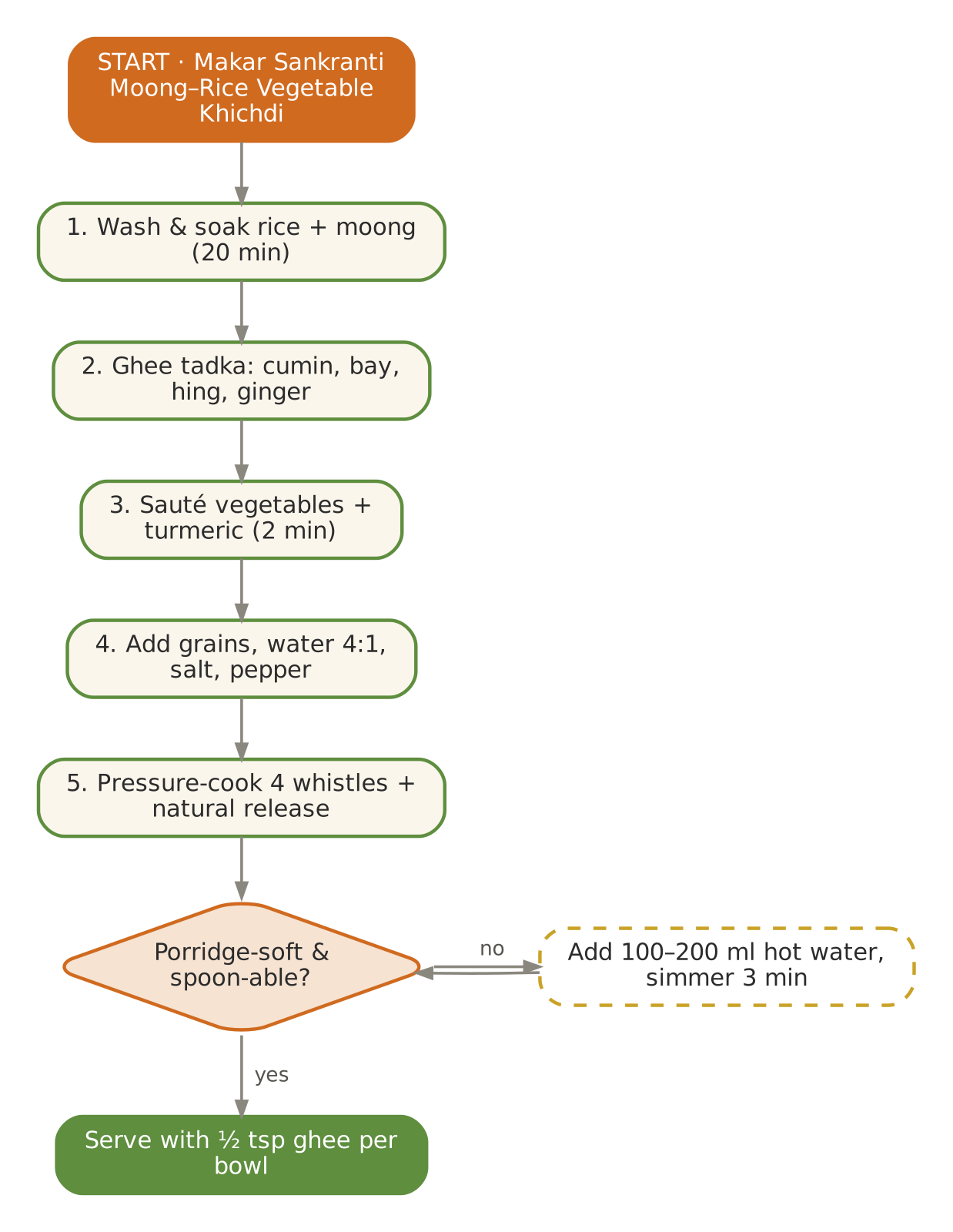 Signature dish: Makar Sankranti Moong–Rice Vegetable Khichdi | Further dishes & variations Breakfast Bajra–moong soft dalia · Methi thepla (soft, with curd) · Gajar–dates porridge · Paneer bhurji (no onion) with phulka · Amaranth (rajgira) lapsi Dals & Saags Kali urad–chana dal (small portion, lunch only) · Methi dana–moong dal · Mooli patta dal · Palak–chana dal · Sarson-saag with paneer Sabzis Gobhi–shalgam mixed · Nimona (green-pea curry, UP) · Methi–aloo · Carrot–beet poriyal · Soft mooli–moong bhurji Evening Gajar kanji (served at room temp, small glass) · Til–gud–sonth chai · Roasted makhana with ghee · Soaked anjeer + almonds · Ginger–jaggery barfi (small) Light Dinners Nimona with soft rice · Vegetable dalia upma · Palak shorba (no cream) + phulka · Sweet-potato–moong soup Sweets & Digestives Gond-free atta ladoo (soft) · Gur-wale chawal · Shakarkandi halwa · Amla candy (post-meal digestive) · Saunf–mishri mukhwas |