July — Kindle the Fire — Shravan & the Kanwar Season
| Hindu months | Ashadha – Shravan |
| Ayurvedic season | Varsha (monsoon) |
| Haridwar weather | ≈ 25 – 33 °C, heavy rain, very humid |
| Agni (digestion) | Weakest of the year — food must be light, warm and well-spiced |
| Dosha picture | Vata aggravated; Pitta accumulating; Kapha from dampness |
| Favour | Sour, salty and a little unctuous; warm, freshly cooked, with ginger, pepper and hing |
| Limit | Raw salads, raw sprouts, leafy greens (uncooked), curd at night, river water, street food, day-old food |
In season
| Vegetables & greens | Fruit | Pantry & other |
|---|---|---|
| Kaddu, arbi, karela, kundru, parwal, lauki, torai, sweet corn, ginger, fresh turmeric | Jamun, pear, plum, peach (hill), early guava, litchi (end) | Old rice, old wheat, honey, rock salt |
Festivals & observances
| Occasion | Kitchen response |
|---|---|
| Guru Purnima (Ashadha Purnima) | Sooji sheera and panchamrit prasad; ashram bhandaras — plan for larger numbers. |
| Shravan month & Kanwar Yatra | Haridwar receives very large numbers of pilgrims; Monday fasts — phalahari options daily. |
| Hariyali Teej (late Jul/Aug) | Ghevar (small piece), kheer, malpua — offer baked/light alternatives. |
Kitchen guidance for July
-
Boil all drinking water; serve only freshly cooked, hot food.
-
Avoid uncooked greens and salads — wash vegetables in salted water; cook leafy greens thoroughly.
-
Add ginger, pepper, ajwain, hing and rock salt generously but not fiery.
-
Serve buttermilk (spiced, at room temperature) instead of curd; no curd after sunset.
-
Fasting (Shravan Mondays): for 55+ guests ensure fluids, phal and makhana; no prolonged dry fasts.
Daily rituals: on waking — Warm water with a pinch of dry ginger; at bedtime — Golden milk with a pinch of dry ginger and nutmeg.
Seven-day menu — July
Rotate weekly; swap any item for one from 'Further dishes & variations' at the end of this chapter. Lunch always includes rice and phulka; curd/raita is served at lunch only.
| Day | Breakfast 7:30–9:00 | Lunch thali 12:30–2:30 | Evening 4:00 | Dinner 7:00–8:30 |
|---|---|---|---|---|
| Monday | Ven pongal · pear | Adraki moong dal with saunth · Khatta-meetha kaddu (Haridwar style) · Arbi ajwaini · rice & phulka · Spiced takra (room temp.) | Ghee–pepper makhana · tulsi tea | Pepper–jeera rasam · soft rice · sweet: Sooji sheera (40 g) |
| Tuesday | Moong dal chilla · ginger chutney | Toor dal with drumstick · Karela–aloo · Kundru thoran · rice & phulka · Ginger–lemon pickle (fresh) | Tulsi–ginger kadha | Moong khichdi · sweet: Rice kheer (60 ml) |
| Wednesday | Dalia upma · stewed apple | Masoor–lauki · Parwal sabzi · Lauki–peas · rice & phulka · Coriander–mint chutney | Corn soup | Vegetable soup · phulka · sweet: Panchamrit (2 tbsp) |
| Thursday | Ragi porridge | Panchmel (light) · Torai–moong · Corn–pumpkin sabzi · rice & phulka · Amla chutney | Stewed pear | Moong yusha · ghee rice · sweet: Dhaniya panjiri (1 tbsp) |
| Friday | Rice idli · tomato-free coconut chutney | Kadhi with ajwain · Beans–carrot thoran · Raw-banana poriyal · rice & phulka · Jeera takra | Roasted bhutta (soft, kernels) | Namkeen dalia · sweet: Banana sheera |
| Saturday | Vegetable poha · papaya | Moong–masoor · Khatta-meetha kaddu (Haridwar style) · Arbi ajwaini · rice & phulka · Spiced takra (room temp.) | CCF tea | Lauki–moong soup · sweet: Ghevar (small piece) |
| Sunday | Oats–moong porridge | Whole moong (soft) · Karela–aloo · Kundru thoran · rice & phulka · Ginger–lemon pickle (fresh) | Plum compote | Kanji with ghee · sweet: Malpua (baked, small) |
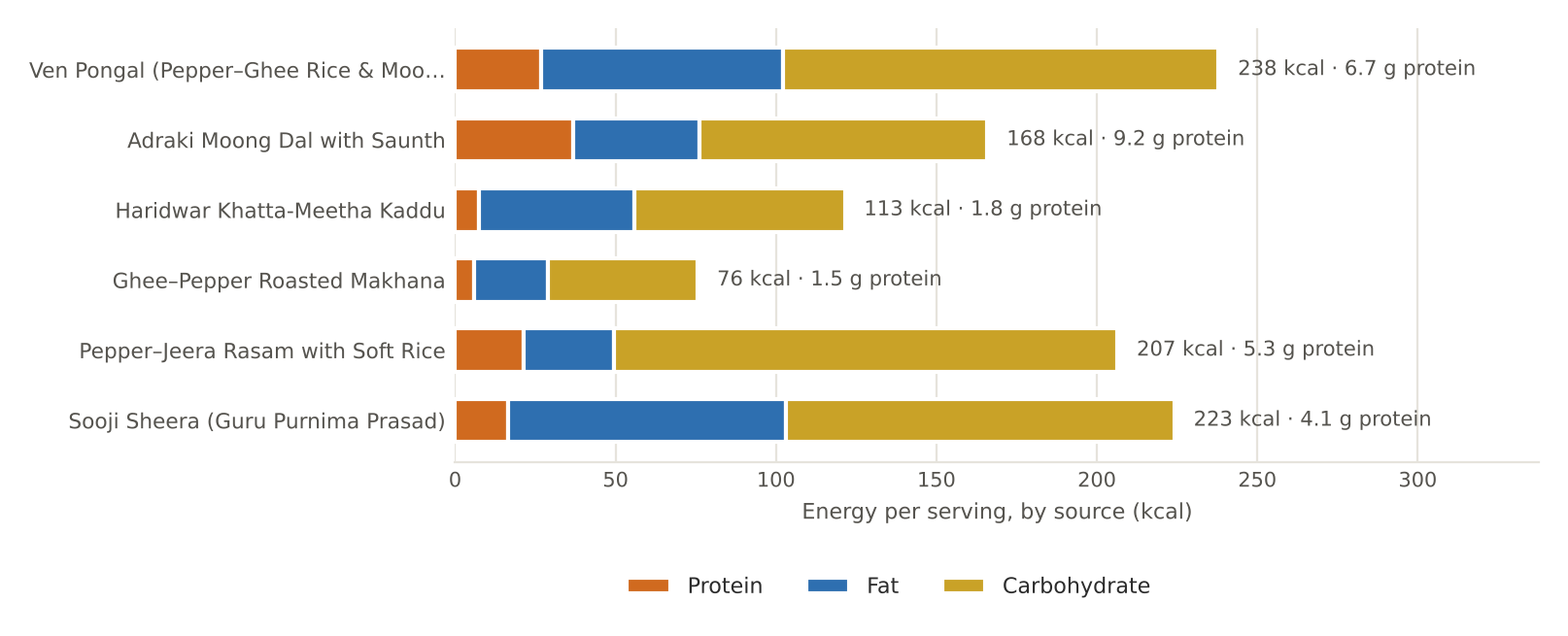
Figure. July's featured recipes — energy per serving by source, with protein
July recipes
Ven Pongal (Pepper–Ghee Rice & Moong)
BREAKFAST · Serves 4 · Portion: 1 bowl (≈250 g) · Cook 30 min
Texture: Soft, creamy Dosha: Kindles agni; Vata-pacifying
| Ingredient | Household measure | Base qty | Café batch ×5 |
|---|---|---|---|
| Rice, white basmati (raw) | ½ cup + 2 tbsp | 120 g | 600 g |
| Moong dal, yellow split | ⅓ cup, dry-roasted | 60 g | 300 g |
| Water | 3¾ cups (5 : 1 soft) | 900 ml | 4,500 ml |
| Ghee (cow) | 5 tsp | 25 g | 125 g |
| Black pepper | 1 tsp whole, crushed | 2 g | 10 g |
| Cumin (jeera) | ½ tsp | 2 g | 10 g |
| Ginger, fresh | 2 tsp grated | 10 g | 50 g |
| Curry leaves | 8 leaves | 1 g | 5 g |
| Asafoetida (hing) | 1 pinch | 0.3 g | 1.5 g |
| Cashew nuts | 10, halved | 15 g | 75 g |
| Rock salt (sendha namak) | ¾ tsp | 4 g | 20 g |
Method
1. Dry-roast moong dal 3 minutes until aromatic.
2. Wash rice and moong; pressure-cook with water — 5 whistles.
3. Mash well while hot.
4. Tadka: ghee, crushed pepper, cumin, ginger, curry leaves, hing and cashews.
5. Mix the tadka and salt into the pongal; loosen with hot water for a creamy texture.
| Per serving | Energy 238 kcal | Protein 6.7 g | Fat 8.4 g | Carbs 34.0 g | Fibre 2.2 g | Salt 1.0 g |
Care notes for 55+ guests Remove cashews for those with chewing difficulty; pepper crushed (not whole) avoids biting into it. | Ayurvedic note Pepper and ginger are deepana (fire-kindling) — exactly what weak monsoon agni needs. |
Variations & further ideas: Sakkarai (sweet) pongal · Millet pongal · Oats pongal · Dalia pongal
Adraki Moong Dal with Saunth
LUNCH · DAL · Serves 4 · Portion: 1 katori (≈180 g) · Cook 30 min
Texture: Soft Dosha: Tridoshic; digestive
| Ingredient | Household measure | Base qty | Café batch ×5 |
|---|---|---|---|
| Moong dal, yellow split | ¾ cup | 150 g | 750 g |
| Water | 3⅓ cups | 800 ml | 4,000 ml |
| Turmeric powder | ¼ tsp | 1 g | 5 g |
| Rock salt (sendha namak) | ¾ tsp | 4 g | 20 g |
| Ghee (cow) | 1 tbsp | 15 g | 75 g |
| Cumin (jeera) | ½ tsp | 2 g | 10 g |
| Asafoetida (hing) | 2 pinches | 0.4 g | 2 g |
| Ginger, fresh | 1 tbsp grated | 15 g | 75 g |
| Dry ginger (saunth) | ½ tsp dry ginger | 1 g | 5 g |
| Black pepper | ¼ tsp | 0.5 g | 2.5 g |
| Lemon juice | 2 tsp | 10 ml | 50 ml |
Method
1. Pressure-cook moong with water and turmeric — 3 whistles; whisk.
2. Tadka: ghee, cumin, hing, fresh ginger; off heat add saunth and pepper.
3. Pour into dal; add salt; simmer 3 minutes.
4. Finish with lemon.
| Per serving | Energy 168 kcal | Protein 9.2 g | Fat 4.4 g | Carbs 22.5 g | Fibre 3.8 g | Salt 1.0 g |
Care notes for 55+ guests Fresh and dry ginger together — the classic monsoon pairing for weak digestion. | Ayurvedic note Sunthi (dry ginger) is called 'vishwabheshaj' — the universal medicine. |
Variations & further ideas: Moong with ajwain · Moong–lauki dal · Hing–jeera dal · Moong soup with ghee
Haridwar Khatta-Meetha Kaddu
LUNCH · SABZI · Serves 4 · Portion: 1 katori (≈150 g) · Cook 30 min
Texture: Soft, half-mashed Dosha: Vata-pacifying, sweet
| Ingredient | Household measure | Base qty | Café batch ×5 |
|---|---|---|---|
| Pumpkin (kaddu) | 2-cm cubes, with skin | 600 g | 3,000 g |
| Mustard oil | 1½ tbsp (or ghee) | 20 g | 100 g |
| Fenugreek seeds | ½ tsp | 1 g | 5 g |
| Fennel (saunf) | 1 tsp | 2 g | 10 g |
| Cumin (jeera) | ¼ tsp | 1 g | 5 g |
| Asafoetida (hing) | 1 pinch | 0.3 g | 1.5 g |
| Ginger, fresh | 2 tsp grated | 10 g | 50 g |
| Turmeric powder | ¼ tsp | 1 g | 5 g |
| Rock salt (sendha namak) | ¾ tsp | 3.5 g | 18 g |
| Water | ¼ cup | 60 ml | 300 ml |
| Coriander seed / powder | 1½ tsp | 3 g | 15 g |
| Kashmiri chilli powder (mild) | ¼ tsp | 1 g | 5 g |
| Dry mango powder (amchur) | 1 tsp | 2 g | 10 g |
| Jaggery (gur) | 1½ tbsp | 20 g | 100 g |
Method
1. Heat mustard oil to smoking; cool slightly.
2. Add methi seeds, fennel, cumin, hing and ginger.
3. Add pumpkin, turmeric and salt; add water, cover and cook on low 12–15 minutes.
4. Mash half the pumpkin with the spatula.
5. Add coriander powder, chilli, amchur and jaggery; cook open 3 minutes.
| Per serving | Energy 113 kcal | Protein 1.8 g | Fat 5.4 g | Carbs 16.4 g | Fibre 1.5 g | Salt 0.9 g |
Care notes for 55+ guests Haridwar's famous puri–kaddu prasad — serve with soft phulka instead of fried puri. Skin softens fully; peel for guests who prefer. | Ayurvedic note Sweet and sour together stimulate appetite gently during monsoon. |
Variations & further ideas: Kaddu–aloo rasa · Pumpkin halwa · Kaddu with coconut (Kerala erissery) · Pumpkin–moong soup
Ghee–Pepper Roasted Makhana
EVENING · SNACK · Serves 4 · Portion: ≈15 g (1 small bowl) · 12 min
Texture: Crisp-melting Dosha: Light; Vata & Pitta pacifying
| Ingredient | Household measure | Base qty | Café batch ×5 |
|---|---|---|---|
| Fox nut (makhana) | 2½ cups | 60 g | 300 g |
| Ghee (cow) | 2 tsp | 10 g | 50 g |
| Black pepper | ½ tsp | 1 g | 5 g |
| Turmeric powder | pinch | 0.3 g | 1.5 g |
| Rock salt (sendha namak) | ¼ tsp | 1.5 g | 7.5 g |
Method
1. Heat ghee on low; add makhana.
2. Roast 8–10 minutes, stirring, until one crushes crisply between fingers.
3. Sprinkle pepper, turmeric and salt; toss.
4. Cool; store airtight up to 1 week.
| Per serving | Energy 76 kcal | Protein 1.5 g | Fat 2.5 g | Carbs 11.7 g | Fibre 0.7 g | Salt 0.4 g |
Care notes for 55+ guests Makhana melts in the mouth; for denture wearers soak briefly in warm milk. | Ayurvedic note Makhana is light, cooling and nourishing — the ideal monsoon snack instead of fried pakoras. |
Variations & further ideas: Makhana kheer · Makhana–peanut chaat (powdered nuts) · Makhana raita (lunch) · Masala makhana with chaat masala
Pepper–Jeera Rasam with Soft Rice
DINNER · Serves 4 · Portion: 200 ml rasam + 150 g rice · Cook 30 min
Texture: Thin soup + soft rice Dosha: Kindles agni; reduces Kapha & Vata
| Ingredient | Household measure | Base qty | Café batch ×5 |
|---|---|---|---|
| Toor / arhar dal | 2 tbsp (cooked, for body) | 30 g | 150 g |
| Tomato | 2 medium, crushed | 150 g | 750 g |
| Tamarind pulp | small marble-sized | 5 g | 25 g |
| Black pepper | 1½ tsp | 3 g | 15 g |
| Cumin (jeera) | 1½ tsp | 3 g | 15 g |
| Ginger, fresh | 2 tsp crushed | 10 g | 50 g |
| Turmeric powder | ⅛ tsp | 0.5 g | 2.5 g |
| Rock salt (sendha namak) | ¾ tsp | 3.5 g | 18 g |
| Water | 3⅓ cups | 800 ml | 4,000 ml |
| Ghee (cow) | 2 tsp | 10 g | 50 g |
| Mustard seeds | ¼ tsp | 1 g | 5 g |
| Asafoetida (hing) | 1 pinch | 0.3 g | 1.5 g |
| Curry leaves | 10 leaves | 2 g | 10 g |
| Coriander leaves | 2 tbsp | 8 g | 40 g |
| Rice, white basmati (raw) | ¾ cup + 1 tbsp | 160 g | 800 g |
| Water | 2⅔ cups (rice, 4 : 1) | 640 ml | 3,200 ml |
Method
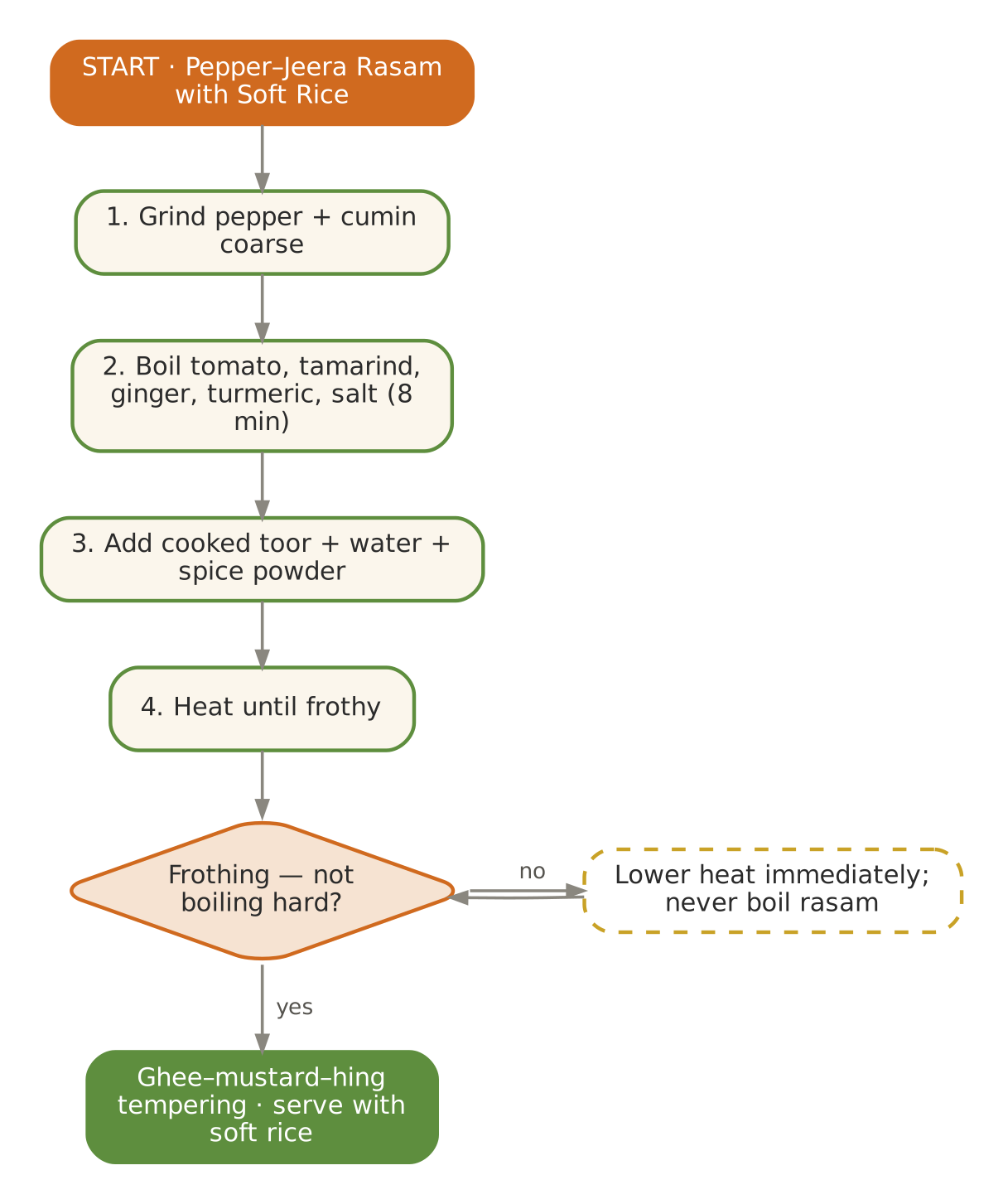
1. Coarsely grind pepper and cumin.
2. Boil tomato, tamarind water, ginger, turmeric and salt in 600 ml water for 8 minutes.
3. Add cooked mashed toor and 200 ml water; add pepper–cumin powder.
4. When it froths, turn off — do not boil hard.
5. Temper with ghee, mustard, hing and curry leaves; add coriander.
6. Rice: cook in 4× water until soft.
| Per serving | Energy 207 kcal | Protein 5.3 g | Fat 3.1 g | Carbs 39.2 g | Fibre 2.3 g | Salt 0.9 g |
Care notes for 55+ guests Mild pepper level for 55+ — increase only on request. Rasam can be sipped from a cup. | Ayurvedic note A deepana–pachana soup: the South Indian remedy for monsoon colds and sluggish digestion. |
Variations & further ideas: Lemon rasam · Tomato-free jeera rasam · Moong-dal rasam · Mysore rasam
Sooji Sheera (Guru Purnima Prasad)
SWEET · Serves 6 · Portion: ≈80 g · Cook 20 min
Texture: Soft, moist Dosha: Vata-pacifying
| Ingredient | Household measure | Base qty | Café batch ×5 |
|---|---|---|---|
| Semolina (suji/rava) | ½ cup + 2 tbsp | 100 g | 500 g |
| Ghee (cow) | 3 tbsp | 40 g | 200 g |
| Cow's milk, whole | 1¼ cups | 300 ml | 1,500 ml |
| Water | ¾ cup + 1 tbsp | 200 ml | 1,000 ml |
| Mishri / sugar | ⅓ cup | 70 g | 350 g |
| Banana, ripe | ½ ripe, sliced | 60 g | 300 g |
| Green cardamom | ¼ tsp | 1 g | 5 g |
| Almonds | 8 slivered | 10 g | 50 g |
| Raisins (kishmish) | 1 tbsp | 10 g | 50 g |
Method
1. Roast suji in ghee on low 8–10 minutes until golden and fragrant.
2. Meanwhile heat milk and water together.
3. Pour hot liquid carefully into suji (it splutters), stirring.
4. Cook 3 minutes until absorbed; add mishri and banana; cook 2 minutes until it leaves the sides.
5. Add cardamom, almonds and raisins.
| Per serving | Energy 223 kcal | Protein 4.1 g | Fat 9.6 g | Carbs 30.3 g | Fibre 1.2 g | Salt 0.0 g |
Care notes for 55+ guests The milk–water mix keeps it soft and moist; reduced ghee from the traditional 1 : 1 ratio. | Ayurvedic note Satyanarayan-style sheera — sweet, unctuous and grounding for Vata. |
Variations & further ideas: Atta sheera · Moong dal halwa · Banana sheera · Rava kesari
Signature process & further dishes — July
 Signature dish: Pepper–Jeera Rasam with Soft Rice | Further dishes & variations Breakfast Ragi dosa · Millet pongal · Hot sweet-corn upma · Moong-dal dosa (pesarattu, no onion) · Dalia khichdi Dals & Saags Kulthi (horse gram) rasam · Ajwain kadhi · Moong with fresh turmeric · Panchmel dal · Toor–drumstick dal Sabzis Arbi patra (steamed) · Karela with jaggery · Kundru–aloo · Corn–kaddu · Raw-banana kofta (steamed) Evening Sweet-corn soup (blended) · Tulsi kadha · Hot ginger–lemon water · Plum compote · Masala makhana Light Dinners Rasam rice · Kanji with pickle-free ginger · Moong khichdi · Vegetable dalia Sweets & Digestives Panchamrit · Ghevar (small) · Dhaniya panjiri · Ajwain–saunf mukhwas · Rice kheer |