September — Kerala Onam & the Pitta Turn
| Hindu months | Bhadrapad – Ashwin |
| Ayurvedic season | Varsha → Sharad (late monsoon to autumn) |
| Haridwar weather | ≈ 23 – 32 °C, rains easing, sunny humid days |
| Agni (digestion) | Recovering — moderate |
| Dosha picture | Pitta aggravated (sudden sun after rains); Vata settling |
| Favour | Sweet, bitter, astringent; cooling, mildly unctuous; ghee preferred to oil |
| Limit | Sour, salty, pungent excess; curd; fried and fermented foods; excessive sun |
In season
| Vegetables & greens | Fruit | Pantry & other |
|---|---|---|
| Lauki, kaddu, arbi, bhindi, torai, ash gourd, raw banana, yam (suran), beans | Guava, pomegranate, pear, apple, custard apple (late), banana | Coconut, singhara (late), old rice |
Festivals & observances
| Occasion | Kitchen response |
|---|---|
| Onam (Kerala, Aug/Sep) | A Sadhya-style Vata–Pitta plate: parippu with ghee, olan, avial, erissery, pachadi, payasam. |
| Ganesh Chaturthi (Bhadrapad) | Steamed ukadiche modak (small), sundal (soft-cooked). |
| Pitru Paksha (Bhadrapad Purnima – Amavasya) | Simple sattvic shraddh food: kheer, kaddu, arbi, puri (offer phulka to elders). |
Kitchen guidance for September
-
Pitta season begins: reduce chilli, sour and salt; increase ghee, milk, rice, coconut.
-
Coconut-based Kerala dishes suit both Vata elders and Pitta season.
-
Bitter vegetables (karela, neem-free methi) twice a week.
-
Shraddh fortnight: keep a simple sattvic thali available for guests performing rites.
Daily rituals: on waking — Room-temperature water with soaked coriander seeds; at bedtime — Warm milk with a pinch of cardamom and mishri.
Seven-day menu — September
Rotate weekly; swap any item for one from 'Further dishes & variations' at the end of this chapter. Lunch always includes rice and phulka; curd/raita is served at lunch only.
| Day | Breakfast 7:30–9:00 | Lunch thali 12:30–2:30 | Evening 4:00 | Dinner 7:00–8:30 |
|---|---|---|---|---|
| Monday | Oats–moong savoury porridge · pomegranate | Kerala parippu (moong with coconut) · Olan (ash gourd & cowpea) · Avial (mixed vegetables, coconut–curd) · rice & phulka · Beetroot pachadi (warm) | Stewed pear with cinnamon & clove | Rice kanji with ghee, cumin & ginger · payar · sweet: Parippu payasam (80 ml) |
| Tuesday | Idiyappam with sweet coconut milk | Lauki–moong dal · Beans thoran · Raw-banana poriyal · rice & phulka · Spiced takra | Coconut water | Moong khichdi · sweet: Rice kheer |
| Wednesday | Puttu (rice flour) with banana | Erissery (pumpkin–lobia) · Kaddu khatta-meetha · Bhindi with coconut · rice & phulka · Coconut chutney | Roasted makhana | Lauki soup · phulka · sweet: Ukadiche modak (1) |
| Thursday | Rice kanji with ghee | Moong yusha · Arbi ajwaini · Lauki–peas · rice & phulka · Inji (ginger) chutney (small) | Pomegranate (½ cup) | Vegetable stew · idiyappam · sweet: Coconut ladoo |
| Friday | Moong dal chilla · coconut chutney | Toor dal (mild) · Carrot–beet thoran · Torai–moong · rice & phulka · Cucumber kichadi | CCF tea | Moong yusha · rice · sweet: Banana–jaggery halwa |
| Saturday | Ragi porridge · guava | Moong–masoor · Olan (ash gourd & cowpea) · Avial (mixed vegetables, coconut–curd) · rice & phulka · Beetroot pachadi (warm) | Banana with cardamom & ghee | Namkeen dalia · sweet: Palada (light, 60 ml) |
| Sunday | Soft upma · pear | Kalan (yam in curd–coconut, lunch) · Beans thoran · Raw-banana poriyal · rice & phulka · Spiced takra | Sweet-potato chaat | Pumpkin–lentil soup · rice · sweet: Sooji kesari (40 g) |
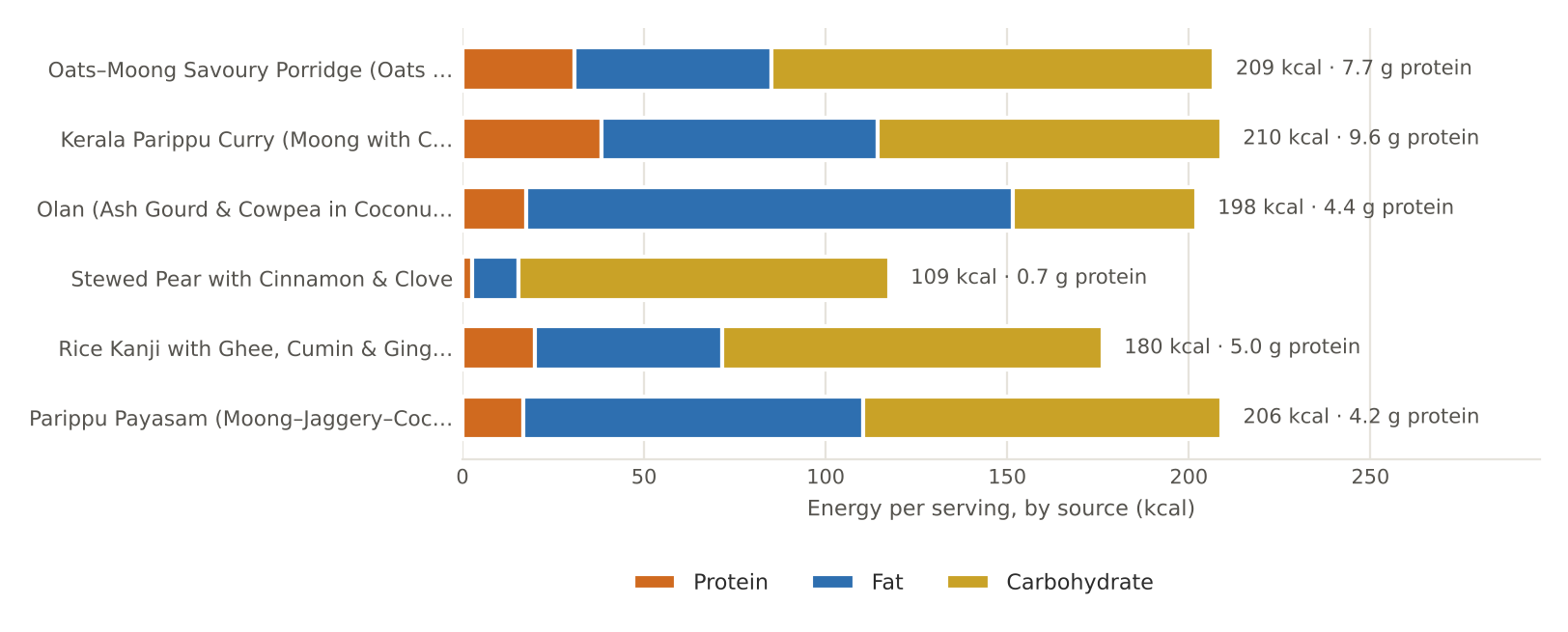
Figure. September's featured recipes — energy per serving by source, with protein
September recipes
Oats–Moong Savoury Porridge (Oats Khichdi)
BREAKFAST · Serves 4 · Portion: 1 bowl (≈250 g) · Cook 25 min
Texture: Soft porridge Dosha: Balancing; heart-friendly
| Ingredient | Household measure | Base qty | Café batch ×5 |
|---|---|---|---|
| Moong dal, yellow split | ¼ cup | 50 g | 250 g |
| Water | 3¾ cups | 900 ml | 4,500 ml |
| Oats, rolled / steel-cut | 1⅓ cups rolled | 120 g | 600 g |
| Carrot | ⅓ cup diced | 50 g | 250 g |
| Green peas, fresh | ¼ cup | 40 g | 200 g |
| Ghee (cow) | 1 tbsp | 15 g | 75 g |
| Cumin (jeera) | ½ tsp | 2 g | 10 g |
| Asafoetida (hing) | 1 pinch | 0.3 g | 1.5 g |
| Ginger, fresh | 1½ tsp | 8 g | 40 g |
| Turmeric powder | ¼ tsp | 1 g | 5 g |
| Rock salt (sendha namak) | ¾ tsp | 3.5 g | 18 g |
| Coriander leaves | 2 tbsp | 8 g | 40 g |
| Lemon juice | 2 tsp | 10 ml | 50 ml |
Method
1. Pressure-cook moong in 400 ml water — 2 whistles.
2. Heat ghee; cumin, hing, ginger; add vegetables and turmeric, sauté 2 minutes.
3. Add oats and roast 2 minutes.
4. Add cooked moong and 500 ml water; simmer 5–6 minutes, stirring, to a porridge.
5. Salt, coriander and lemon to finish.
| Per serving | Energy 209 kcal | Protein 7.7 g | Fat 6.0 g | Carbs 30.5 g | Fibre 5.3 g | Salt 0.9 g |
Care notes for 55+ guests Oats' soluble fibre (beta-glucan) supports healthy cholesterol — useful for many 55+ guests. | Ayurvedic note Light and warm, with moong for protein; suitable through the season change. |
Variations & further ideas: Masala oats (no onion) · Oats idli · Sweet oats with dates · Oats–vegetable soup
Kerala Parippu Curry (Moong with Coconut)
LUNCH · DAL · Serves 4 · Portion: 1 katori (≈170 g) · Cook 30 min
Texture: Soft, smooth Dosha: Pitta & Vata pacifying
| Ingredient | Household measure | Base qty | Café batch ×5 |
|---|---|---|---|
| Moong dal, yellow split | ¾ cup, lightly roasted | 150 g | 750 g |
| Water | 3 cups | 700 ml | 3,500 ml |
| Turmeric powder | ¼ tsp | 1 g | 5 g |
| Coconut, fresh grated | ½ cup grated | 50 g | 250 g |
| Cumin (jeera) | ½ tsp (ground with coconut) | 2 g | 10 g |
| Green chilli (optional, deseeded) | ½ (optional) | 2 g | 10 g |
| Water | ¼ cup (grinding) | 60 ml | 300 ml |
| Rock salt (sendha namak) | ¾ tsp | 4 g | 20 g |
| Ghee (cow) | 1 tbsp | 15 g | 75 g |
| Mustard seeds | ½ tsp | 2 g | 10 g |
| Curry leaves | 8 leaves | 1 g | 5 g |
| Asafoetida (hing) | small pinch | 0.2 g | 1 g |
Method
1. Roast moong lightly 3 minutes; pressure-cook with water and turmeric — 4 whistles; mash smooth.
2. Grind coconut, cumin and chilli with water to a fine paste.
3. Add paste to the dal; simmer gently 5 minutes (do not boil hard); add salt.
4. Temper with ghee, mustard, curry leaves and hing.
5. Serve as the Sadhya first course: over rice with a spoon of ghee.
| Per serving | Energy 210 kcal | Protein 9.6 g | Fat 8.5 g | Carbs 23.6 g | Fibre 4.8 g | Salt 1.0 g |
Care notes for 55+ guests Smooth and mild — one of the gentlest dals in the book. | Ayurvedic note Coconut and ghee cool Pitta; moong is light — perfect for the Varsha-to-Sharad transition. |
Variations & further ideas: Parippu with spinach · Cherupayar (whole moong) curry · Moong–coconut kootu · Dal with coconut milk
Olan (Ash Gourd & Cowpea in Coconut Milk)
LUNCH · SABZI · Serves 4 · Portion: 1 katori (≈170 g) · Soak overnight · Cook 35 min
Texture: Very soft Dosha: Cooling; Pitta-pacifying
| Ingredient | Household measure | Base qty | Café batch ×5 |
|---|---|---|---|
| Cowpea (lobia), dry | ¼ cup, soaked overnight | 50 g | 250 g |
| Ash gourd (petha) | thin 3-cm squares | 400 g | 2,000 g |
| Coconut milk, thin | 1⅔ cups (300 thin + 100 thick) | 400 ml | 2,000 ml |
| Green chilli (optional, deseeded) | ½, slit (optional) | 2 g | 10 g |
| Ginger, fresh | 1 tsp julienne | 5 g | 25 g |
| Rock salt (sendha namak) | ½ tsp | 3 g | 15 g |
| Coconut oil | 2 tsp (raw, to finish) | 10 g | 50 g |
| Curry leaves | 8 leaves | 1 g | 5 g |
Method
1. Pressure-cook soaked lobia 5 whistles until completely soft.
2. Simmer ash gourd in thin coconut milk with chilli, ginger and salt 10–12 minutes until translucent.
3. Add lobia; stir gently.
4. Pour in thick coconut milk and warm through — do not boil.
5. Finish with raw coconut oil and curry leaves.
| Per serving | Energy 198 kcal | Protein 4.4 g | Fat 14.9 g | Carbs 12.6 g | Fibre 4.8 g | Salt 0.8 g |
Care notes for 55+ guests No spice powders at all — the mildest dish in the book; ideal for sensitive stomachs. | Ayurvedic note Ash gourd (kushmanda) is cooling and nourishing — celebrated in Ayurveda for calming Pitta and the mind. |
Variations & further ideas: Pumpkin olan · Lauki in coconut milk · Erissery · Kootu with ash gourd
Stewed Pear with Cinnamon & Clove
EVENING · SNACK · Serves 4 · Portion: ≈130 g · Cook 20 min
Texture: Spoon-soft Dosha: Vata-pacifying when stewed
| Ingredient | Household measure | Base qty | Café batch ×5 |
|---|---|---|---|
| Pear | 4 medium, peeled & cored | 500 g | 2,500 g |
| Water | ¾ cup + 1 tbsp | 200 ml | 1,000 ml |
| Cinnamon | 1-inch stick | 1 g | 5 g |
| Clove | 2 | 0.3 g | 1.5 g |
| Green cardamom | 1 pod | 0.3 g | 1.5 g |
| Raisins (kishmish) | 1 tbsp | 15 g | 75 g |
| Jaggery (gur) | 1 tbsp (optional) | 15 g | 75 g |
| Ghee (cow) | 1 tsp | 5 g | 25 g |
Method
1. Cut pears into 2-cm pieces.
2. Simmer with water, spices and raisins covered 12–15 minutes until spoon-soft.
3. Stir in jaggery (optional) and ghee.
4. Remove whole spices; serve warm.
| Per serving | Energy 109 kcal | Protein 0.7 g | Fat 1.4 g | Carbs 25.5 g | Fibre 4.1 g | Salt 0.0 g |
Care notes for 55+ guests From the source Kerala plan. Stewing makes raw fruit (Vata-aggravating) gentle; good for constipation. | Ayurvedic note Cooked fruit with warming spices is far easier on aged digestion than raw fruit. |
Variations & further ideas: Stewed apple · Stewed guava · Baked apple with dates · Pear–ginger compote
Rice Kanji with Ghee, Cumin & Ginger · Payar
DINNER · Serves 4 · Portion: 300 ml kanji + 2 tbsp payar · Cook 45 min
Texture: Thin porridge Dosha: Tridoshic; restorative
| Ingredient | Household measure | Base qty | Café batch ×5 |
|---|---|---|---|
| Rice, Kerala red matta (raw) | ½ cup red matta (or njavara/basmati) | 100 g | 500 g |
| Water | 5 cups | 1,200 ml | 6,000 ml |
| Rock salt (sendha namak) | ½ tsp | 3 g | 15 g |
| Ghee (cow) | 1 tbsp | 15 g | 75 g |
| Cumin (jeera) | ½ tsp | 2 g | 10 g |
| Ginger, fresh | 2 tsp grated | 10 g | 50 g |
| Moong, whole green | ¼ cup whole moong (payar), soaked | 50 g | 250 g |
| Coconut, fresh grated | 1½ tbsp grated | 15 g | 75 g |
| Mustard seeds | ¼ tsp | 1 g | 5 g |
| Curry leaves | 5 leaves | 1 g | 5 g |
Method
1. Wash rice; boil in 1200 ml water, open pot, 35–40 minutes (or 5 whistles) until grains burst and the liquid is starchy.
2. Add salt; temper with ghee, cumin and ginger.
3. Payar: pressure-cook soaked whole moong 5 whistles until soft.
4. Temper payar with a few drops of ghee, mustard and curry leaves; stir in coconut.
5. Serve kanji in a bowl with payar alongside.
| Per serving | Energy 180 kcal | Protein 5.0 g | Fat 5.7 g | Carbs 26.2 g | Fibre 3.5 g | Salt 0.8 g |
Care notes for 55+ guests Red matta must be double-cooked until very soft. Kanji is the classic Kerala sick-room and elder food. | Ayurvedic note Peya/yavagu (thin rice gruel) is the first food after fasting or illness in Ayurveda. |
Variations & further ideas: Njavara milk kanji (sweet, with dates) · Jeera kanji · Moong kanji · Ragi kanji
Parippu Payasam (Moong–Jaggery–Coconut Milk)
SWEET · Serves 8 · Portion: 80 ml · Cook 40 min
Texture: Thick, smooth Dosha: Nourishing, Vata-pacifying
| Ingredient | Household measure | Base qty | Café batch ×5 |
|---|---|---|---|
| Moong dal, yellow split | ½ cup | 100 g | 500 g |
| Ghee (cow) | 1 tbsp | 15 g | 75 g |
| Water | 1⅔ cups | 400 ml | 2,000 ml |
| Jaggery (gur) | ⅔ cup grated | 120 g | 600 g |
| Coconut milk, thin | 2 cups (350 thin + 150 thick) | 500 ml | 2,500 ml |
| Green cardamom | ¼ tsp | 1 g | 5 g |
| Dry ginger (saunth) | ¼ tsp dry ginger | 0.5 g | 2.5 g |
| Cashew nuts | 10 | 15 g | 75 g |
| Raisins (kishmish) | 1 tbsp | 10 g | 50 g |
Method
1. Roast moong in 1 tsp ghee 4 minutes; pressure-cook with 300 ml water — 3 whistles; mash.
2. Melt jaggery in 100 ml water; strain.
3. Add jaggery to dal; cook 8 minutes to thicken.
4. Add thin coconut milk; simmer 8 minutes; add thick milk and heat through.
5. Off heat add cardamom and dry ginger; top with ghee-fried cashews and raisins.
| Per serving | Energy 206 kcal | Protein 4.2 g | Fat 10.4 g | Carbs 24.6 g | Fibre 1.6 g | Salt 0.0 g |
Care notes for 55+ guests Rich — serve 80 ml. Diabetic guests: 2 tbsp only. | Ayurvedic note Dry ginger in payasam aids digestion of the heavy jaggery and coconut — a Kerala wisdom. |
Variations & further ideas: Ada pradhaman (light) · Pal payasam · Semiya payasam · Chana dal payasam
Signature process & further dishes — September
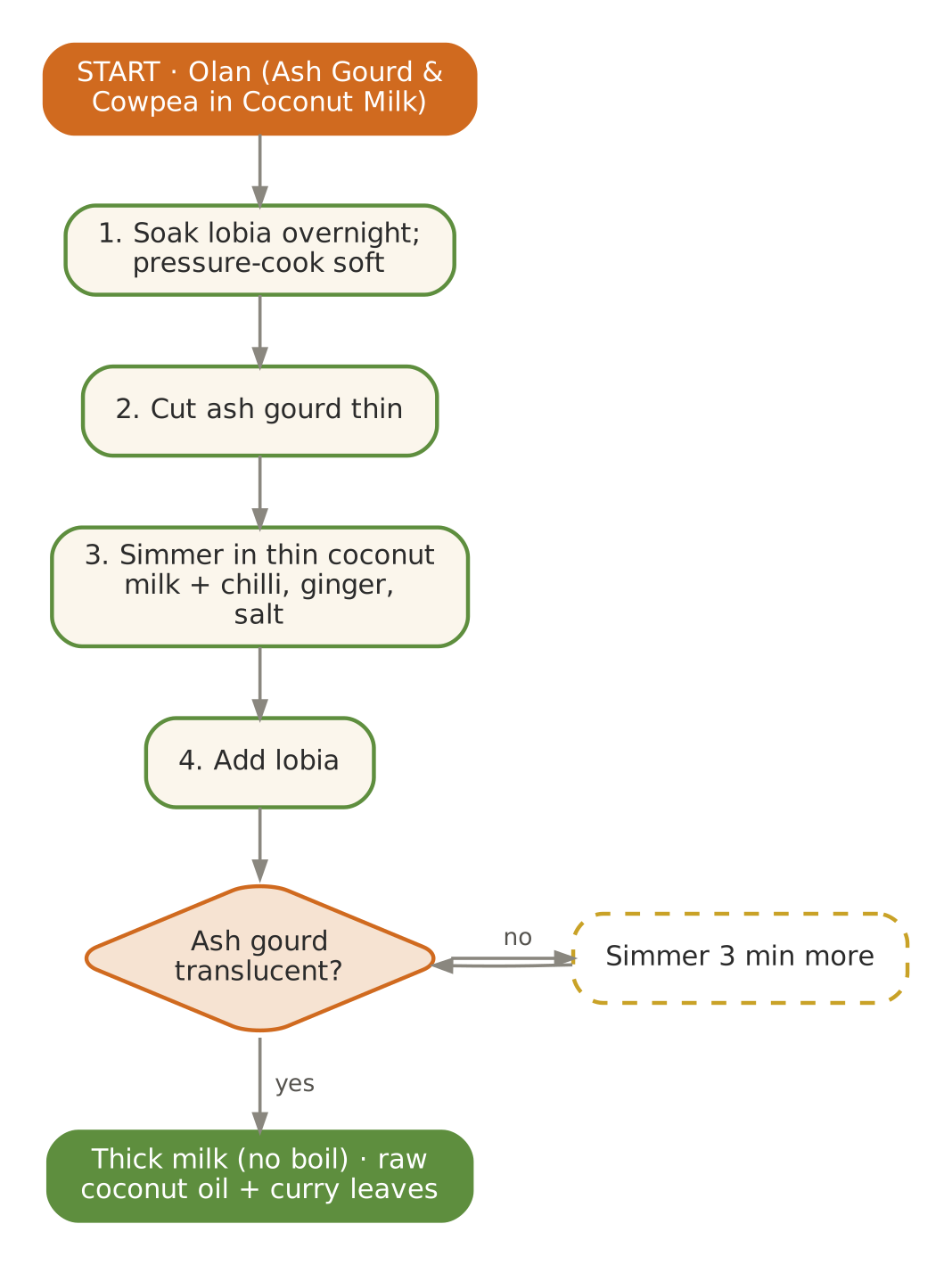 Signature dish: Olan (Ash Gourd & Cowpea in Coconut Milk) | Further dishes & variations Breakfast Puttu with kadala (soft-cooked) · Neer dosa · Appam with stew · Kozhukattai (steamed rice dumplings) · Oats idli Dals & Saags Erissery · Kalan (lunch) · Moru curry (spiced buttermilk) · Cherupayar curry · Moong–spinach kootu Sabzis Avial · Kootu · Raw-banana thoran · Yam erissery · Beans–coconut thoran Evening Banana with ghee & cardamom · Coconut water · Stewed apple · Pomegranate · Sukku (dry-ginger) tea Light Dinners Kanji · Pumpkin–lentil soup · Idiyappam with stew · Moong khichdi Sweets & Digestives Ukadiche modak · Palada · Coconut ladoo · Pal payasam · Saunf–mishri |