August — Light, Warm & Immunity — Janmashtami Month
| Hindu months | Shravan – Bhadrapad |
| Ayurvedic season | Varsha (peak monsoon) |
| Haridwar weather | ≈ 25 – 32 °C, continuous rain, very humid |
| Agni (digestion) | Weak — keep meals small and warm |
| Dosha picture | Vata at its peak; Pitta accumulating |
| Favour | Sour, salty, sweet in moderation; warm, freshly cooked, mildly spiced |
| Limit | Curd at night, uncooked greens, heavy fried snacks, cold drinks, day-old food |
In season
| Vegetables & greens | Fruit | Pantry & other |
|---|---|---|
| Lauki, torai, arbi, kakdi, kundru, karela, ginger, fresh turmeric, corn, bhindi | Guava, pear, plum, apple (early), banana, papaya | Coriander seeds, ajwain, tulsi |
Festivals & observances
| Occasion | Kitchen response |
|---|---|
| Raksha Bandhan (Shravan Purnima) | Soft mithai: date–nut ladoo, kesar peda (small). |
| Janmashtami (Bhadrapad Krishna Ashtami) | Dhaniya panjiri, makhan–mishri, panchamrit; midnight prasad — keep portions tiny for elders. |
| Hariyali / Kajari Teej | Light ghevar piece; sattvic thali. |
Kitchen guidance for August
-
Small, frequent warm meals; never reheat food more than once.
-
Cook leafy greens thoroughly or avoid; prefer gourds, roots and pulses.
-
Every lunch includes a digestive: ginger slices with rock salt and lemon before the meal.
-
Watch for joint stiffness and low mood in elders — warm oil massage days, warm food, sunlight when available.
Daily rituals: on waking — Warm water with a pinch of ajwain or dry ginger; at bedtime — Golden milk with dry ginger.
Seven-day menu — August
Rotate weekly; swap any item for one from 'Further dishes & variations' at the end of this chapter. Lunch always includes rice and phulka; curd/raita is served at lunch only.
| Day | Breakfast 7:30–9:00 | Lunch thali 12:30–2:30 | Evening 4:00 | Dinner 7:00–8:30 |
|---|---|---|---|---|
| Monday | Moong dal dhokla · mint chutney | Moong–masoor with fresh turmeric · Arbi ajwaini · Lauki–peas · rice & phulka · Jeera takra | Dhaniya panjiri · tulsi tea | Monsoon clear vegetable soup · ghee rice · sweet: Seviyan kheer with dates (60 ml) |
| Tuesday | Ven pongal | Adraki moong dal · Torai–moong · Kundru thoran · rice & phulka · Ginger–lemon slices | Roasted makhana | Moong khichdi · sweet: Panchamrit |
| Wednesday | Vegetable dalia upma · pear | Ajwain kadhi · Karela with jaggery · Bhindi with coconut · rice & phulka · Coriander chutney | Corn soup | Rasam · rice · sweet: Makhan–mishri (1 tsp) |
| Thursday | Ragi porridge · banana | Toor dal (mild) · Kaddu khatta-meetha · Corn–capsicum (soft) · rice & phulka · Amla chutney | Stewed pear | Lauki–moong soup · phulka · sweet: Date–nut ladoo |
| Friday | Rice idli · coconut chutney | Moong–lauki dal · Parwal sabzi · Raw-banana poriyal · rice & phulka · Guava chutney | Ginger–honey tea | Namkeen dalia · sweet: Sooji sheera (40 g) |
| Saturday | Oats–moong porridge | Whole moong (soft) · Arbi ajwaini · Lauki–peas · rice & phulka · Jeera takra | Steamed corn kernels with ghee & lemon | Moong yusha · sweet: Kesar peda (½) |
| Sunday | Soft besan chilla · guava | Panchmel (light) · Torai–moong · Kundru thoran · rice & phulka · Ginger–lemon slices | CCF tea | Kanji with payar · sweet: Rice kheer |
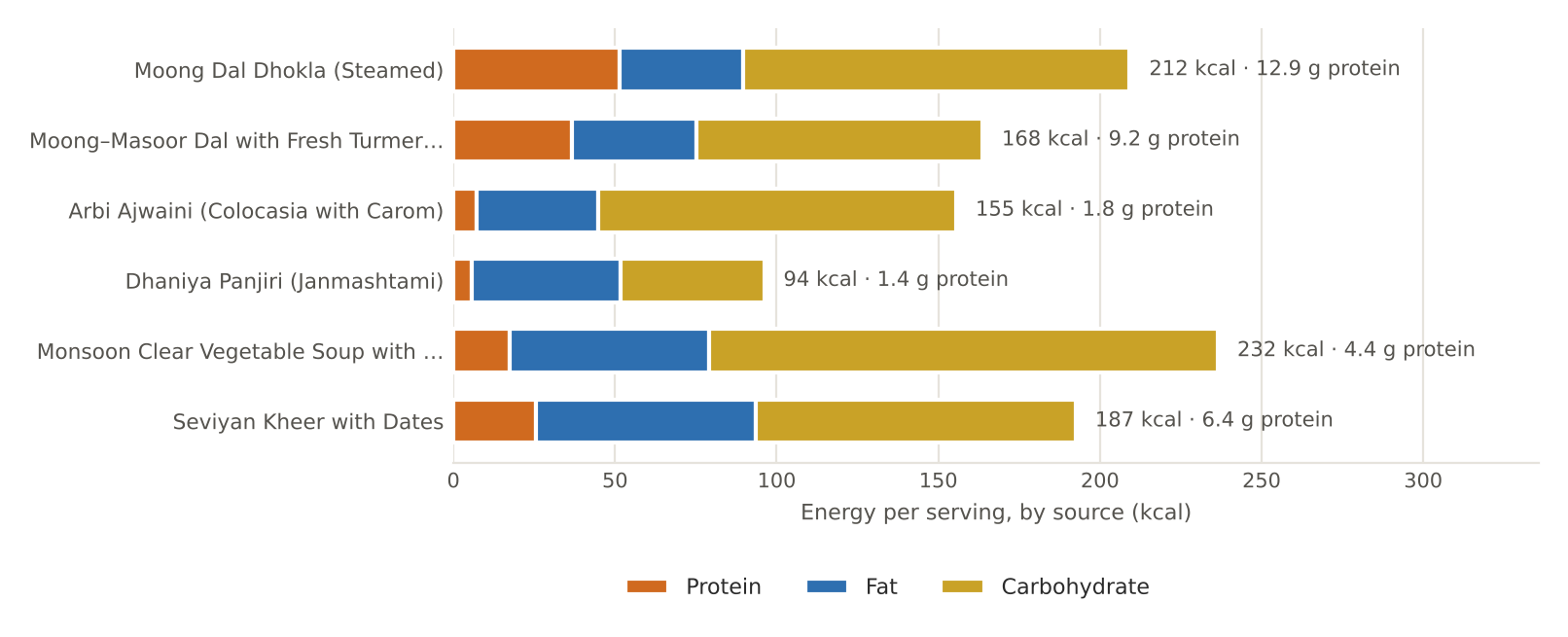
Figure. August's featured recipes — energy per serving by source, with protein
August recipes
Moong Dal Dhokla (Steamed)
BREAKFAST · Serves 4 · Portion: 4 pieces (≈150 g) · Soak 4 h · Steam 15 min
Texture: Soft, spongy Dosha: Light; Kapha- and Pitta-friendly
| Ingredient | Household measure | Base qty | Café batch ×5 |
|---|---|---|---|
| Moong dal, yellow split | 1 cup, soaked 4 h | 200 g | 1,000 g |
| Ginger, fresh | 2 tsp | 10 g | 50 g |
| Green chilli (optional, deseeded) | ½ (optional) | 2 g | 10 g |
| Water | ½ cup (grinding) | 120 ml | 600 ml |
| Curd (dahi), plain | ¼ cup | 60 g | 300 g |
| Rock salt (sendha namak) | ¾ tsp | 3.5 g | 18 g |
| Turmeric powder | ⅛ tsp | 0.5 g | 2.5 g |
| Asafoetida (hing) | small pinch | 0.2 g | 1 g |
| Fruit salt (Eno) / leavening | 1 tsp fruit salt | 4 g | 20 g |
| Ghee (cow) | 2 tsp (tempering) | 10 g | 50 g |
| Mustard seeds | ½ tsp | 2 g | 10 g |
| Sesame seeds (til) | 1 tsp | 4 g | 20 g |
| Curry leaves | 8 leaves | 1 g | 5 g |
| Coriander leaves | 2 tbsp | 8 g | 40 g |
Method
1. Grind soaked moong with ginger, chilli and minimal water to a thick batter.
2. Mix in curd, salt, turmeric and hing; rest 30 minutes.
3. Grease a thali; heat the steamer. Add fruit salt and 1 tbsp water to the batter; whisk briefly.
4. Pour into the thali; steam 15 minutes; check with a toothpick.
5. Cool 5 minutes; cut. Temper ghee, mustard, sesame and curry leaves with 3 tbsp water; drizzle to keep moist.
| Per serving | Energy 212 kcal | Protein 12.9 g | Fat 4.3 g | Carbs 29.9 g | Fibre 4.9 g | Salt 0.9 g |
Care notes for 55+ guests The water in the tempering keeps dhokla moist for easy swallowing. | Ayurvedic note Steamed moong is light (laghu) — a protein breakfast that respects weak monsoon agni. |
Variations & further ideas: Besan khaman · Rava dhokla · Lauki–moong dhokla · Khatta dhokla (rice–urad)
Moong–Masoor Dal with Fresh Turmeric & Ginger
LUNCH · DAL · Serves 4 · Portion: 1 katori (≈180 g) · Cook 30 min
Texture: Soft Dosha: Tridoshic; anti-inflammatory spices
| Ingredient | Household measure | Base qty | Café batch ×5 |
|---|---|---|---|
| Moong dal, yellow split | ⅓ cup + 1 tbsp | 80 g | 400 g |
| Masoor dal (red lentil) | ⅓ cup | 70 g | 350 g |
| Water | 3½ cups | 850 ml | 4,250 ml |
| Fresh turmeric root | 2 tsp grated fresh root | 10 g | 50 g |
| Ginger, fresh | 2 tsp grated | 10 g | 50 g |
| Rock salt (sendha namak) | ¾ tsp | 4 g | 20 g |
| Ghee (cow) | 1 tbsp | 15 g | 75 g |
| Cumin (jeera) | ½ tsp | 2 g | 10 g |
| Asafoetida (hing) | 1 pinch | 0.3 g | 1.5 g |
| Kashmiri chilli powder (mild) | pinch | 0.5 g | 2.5 g |
| Coriander leaves | 2 tbsp | 8 g | 40 g |
Method
1. Pressure-cook dals with water and half the fresh turmeric — 3 whistles; whisk.
2. Tadka: ghee, cumin, hing, remaining turmeric and ginger; sauté 1 minute.
3. Add chilli off heat; pour into dal; add salt; simmer 3 minutes.
4. Garnish with coriander.
| Per serving | Energy 168 kcal | Protein 9.2 g | Fat 4.2 g | Carbs 22.1 g | Fibre 3.9 g | Salt 1.0 g |
Care notes for 55+ guests Fresh turmeric is milder and more aromatic than powder; it stains — use a steel spoon. | Ayurvedic note Haridra (turmeric) supports joints and immunity — useful for monsoon aches common after 55. |
Variations & further ideas: Turmeric pickle (fresh, small) · Turmeric–ginger milk · Moong with ajwain · Masoor–lauki dal
Arbi Ajwaini (Colocasia with Carom)
LUNCH · SABZI · Serves 4 · Portion: ½ katori (≈90 g) · Cook 30 min
Texture: Soft inside Dosha: Ajwain & hing counter arbi's heaviness
| Ingredient | Household measure | Base qty | Café batch ×5 |
|---|---|---|---|
| Colocasia (arbi) | ≈8 medium | 400 g | 2,000 g |
| Mustard oil | 1 tbsp | 15 g | 75 g |
| Carom (ajwain) | ¾ tsp | 2 g | 10 g |
| Asafoetida (hing) | 1 pinch | 0.3 g | 1.5 g |
| Ginger, fresh | 2 tsp grated | 10 g | 50 g |
| Turmeric powder | ¼ tsp | 1 g | 5 g |
| Coriander seed / powder | 1½ tsp | 3 g | 15 g |
| Kashmiri chilli powder (mild) | ¼ tsp | 1 g | 5 g |
| Dry mango powder (amchur) | 1 tsp | 2 g | 10 g |
| Rock salt (sendha namak) | ¾ tsp | 3.5 g | 18 g |
| Coriander leaves | 2 tbsp | 8 g | 40 g |
Method
1. Pressure-cook arbi in its skin — 2 whistles (don't overcook).
2. Cool, peel and flatten each lightly between palms.
3. Heat oil; add ajwain, hing, ginger.
4. Add arbi with turmeric, coriander powder, chilli and salt; pan-roast on low 8–10 minutes until edges turn golden.
5. Sprinkle amchur and coriander.
| Per serving | Energy 155 kcal | Protein 1.8 g | Fat 4.2 g | Carbs 27.7 g | Fibre 4.8 g | Salt 0.9 g |
Care notes for 55+ guests Keep portions small (≈90 g) — arbi is heavy. Wear gloves when peeling raw arbi (itchy). | Ayurvedic note Arbi is guru and Vata-provoking (gas); ajwain is its classical antidote. |
Variations & further ideas: Arbi patra (steamed leaf rolls) · Arbi in curd gravy (lunch) · Arbi–kadhi · Arbi chips (baked)
Dhaniya Panjiri (Janmashtami)
EVENING · PRASAD · Serves 10 · Portion: 1 tbsp heap (≈22 g) · 20 min
Texture: Powdery Dosha: Cooling, digestive
| Ingredient | Household measure | Base qty | Café batch ×5 |
|---|---|---|---|
| Coriander seed / powder | ½ cup coriander powder | 60 g | 300 g |
| Ghee (cow) | 2 tbsp | 30 g | 150 g |
| Fox nut (makhana) | 1 cup, roasted & crushed | 30 g | 150 g |
| Almonds | 15, chopped | 20 g | 100 g |
| Coconut, fresh grated | 3 tbsp dry grated | 20 g | 100 g |
| Mishri / sugar | ¼ cup powdered | 50 g | 250 g |
| Green cardamom | ⅛ tsp | 0.5 g | 2.5 g |
Method
1. Heat 3 tsp ghee; roast coriander powder on low 4–5 minutes until the aroma changes — do not burn.
2. Roast makhana in the remaining ghee; crush coarsely.
3. Dry-roast almonds and coconut.
4. Cool everything; mix with powdered mishri and cardamom.
5. Store airtight up to 2 weeks.
| Per serving | Energy 94 kcal | Protein 1.4 g | Fat 5.1 g | Carbs 11.1 g | Fibre 2.1 g | Salt 0.0 g |
Care notes for 55+ guests Powdered texture — easy for all. Serve with a sip of water to avoid coughing on dry powder. | Ayurvedic note Dhanyaka (coriander) is deepana–pachana and cooling — the ideal monsoon prasad. |
Variations & further ideas: Atta panjiri · Makhana panjiri · Gond-free dry-fruit panjiri · Dhaniya–saunf digestive
Monsoon Clear Vegetable Soup with Ghee Rice
DINNER · Serves 4 · Portion: 250 ml soup + 150 g rice · Cook 30 min
Texture: Soft vegetables in broth Dosha: Light, warming
| Ingredient | Household measure | Base qty | Café batch ×5 |
|---|---|---|---|
| Ghee (cow) | 1 tbsp | 15 g | 75 g |
| Ginger, fresh | 1 tbsp grated | 15 g | 75 g |
| Cumin (jeera) | ¼ tsp | 1 g | 5 g |
| Carrot | 1 small, fine dice | 80 g | 400 g |
| French beans | 8, fine | 60 g | 300 g |
| Cabbage | ½ cup shredded | 60 g | 300 g |
| Sweet corn kernels | ⅓ cup kernels | 50 g | 250 g |
| Bottle gourd (lauki) | ¾ cup diced | 100 g | 500 g |
| Water | 4 cups | 1,000 ml | 5,000 ml |
| Black pepper | ½ tsp | 1 g | 5 g |
| Rock salt (sendha namak) | ¾ tsp | 3.5 g | 18 g |
| Lemon juice | 2 tsp | 10 ml | 50 ml |
| Coriander leaves | 1 tbsp | 5 g | 25 g |
| Rice, white basmati (raw) | ¾ cup + 1 tbsp | 160 g | 800 g |
| Water | 2⅔ cups (rice) | 640 ml | 3,200 ml |
| Ghee (cow) | 2 tsp (rice) | 10 g | 50 g |
Method
1. Heat ghee; add ginger and cumin for 30 seconds.
2. Add finely chopped vegetables; sauté 3 minutes.
3. Add water; simmer 15 minutes until soft.
4. Season with pepper and salt; lemon off the heat.
5. Rice: cook soft; stir in ghee.
| Per serving | Energy 232 kcal | Protein 4.4 g | Fat 6.8 g | Carbs 39.4 g | Fibre 2.7 g | Salt 0.9 g |
Care notes for 55+ guests Corn kernels can be pulsed briefly for those who cannot chew skins. | Ayurvedic note Warm, light and freshly made — perfect for weak monsoon digestion. |
Variations & further ideas: Sweet-corn soup · Lauki–ginger soup · Moong–vegetable soup · Tulsi–vegetable broth
Seviyan Kheer with Dates
SWEET · Serves 6 · Portion: 100 ml · Cook 25 min
Texture: Soft Dosha: Vata-pacifying
| Ingredient | Household measure | Base qty | Café batch ×5 |
|---|---|---|---|
| Wheat vermicelli (seviyan) | ¾ cup broken vermicelli | 60 g | 300 g |
| Ghee (cow) | 1 tsp | 5 g | 25 g |
| Cow's milk, whole | 3¾ cups | 900 ml | 4,500 ml |
| Dates, seedless | 6–7 seedless, pureed | 50 g | 250 g |
| Mishri / sugar | 1½ tbsp | 20 g | 100 g |
| Green cardamom | ¼ tsp | 1 g | 5 g |
| Almonds | 8, slivered | 10 g | 50 g |
Method
1. Roast seviyan in ghee 3 minutes until golden.
2. Boil milk and reduce 10 minutes.
3. Add seviyan; cook 8 minutes until soft.
4. Blend dates with 2 tbsp milk; stir in with mishri; simmer 2 minutes.
5. Add cardamom and almonds.
| Per serving | Energy 187 kcal | Protein 6.4 g | Fat 7.5 g | Carbs 24.7 g | Fibre 1.1 g | Salt 0.0 g |
Care notes for 55+ guests Dates replace most of the sugar; diabetic portion 50 ml. | Ayurvedic note Dates (kharjura) with milk is a classical strengthening combination. |
Variations & further ideas: Sheer khurma (light) · Semiya payasam · Rice kheer · Lauki kheer
Signature process & further dishes — August
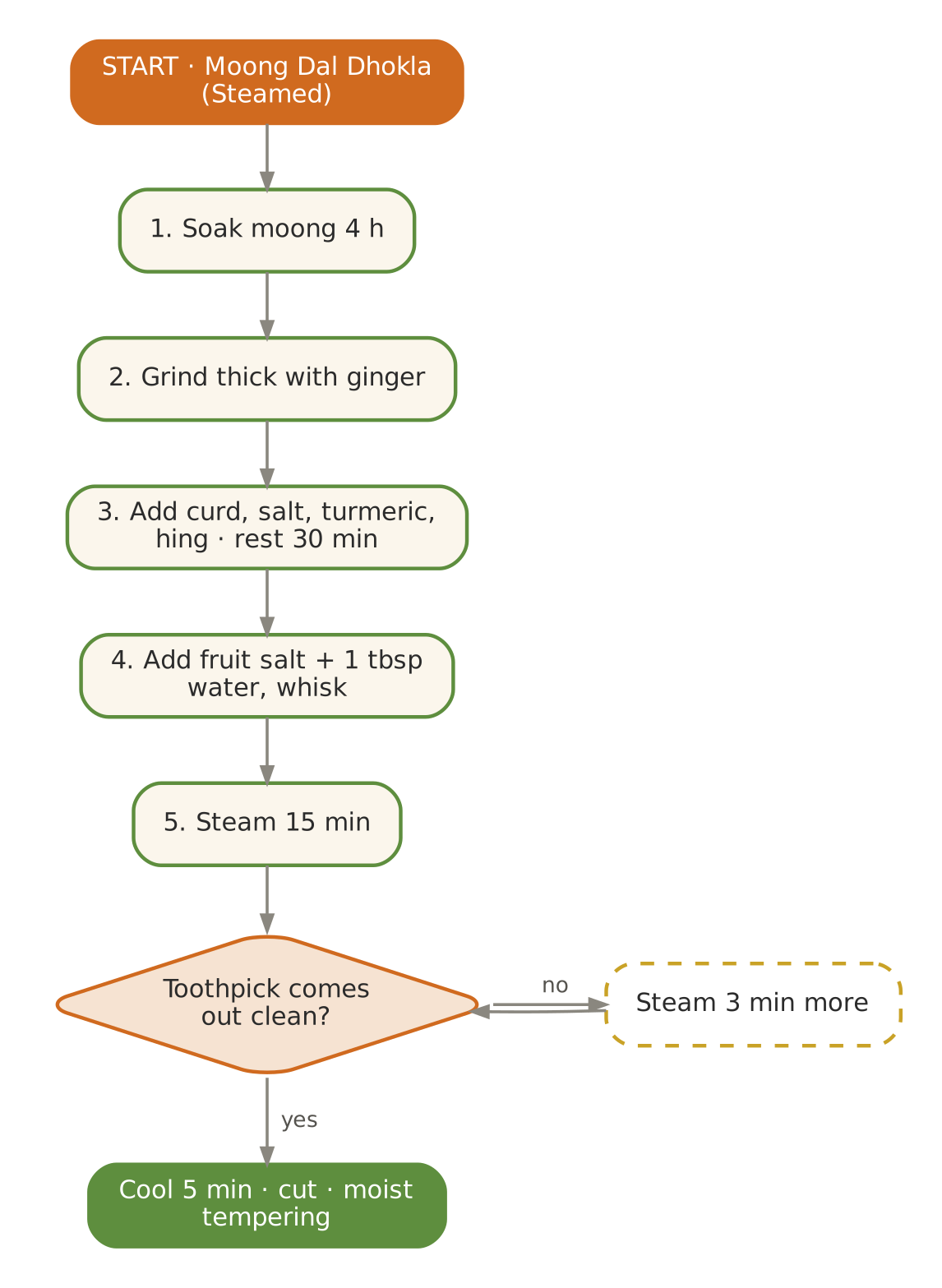 Signature dish: Moong Dal Dhokla (Steamed) | Further dishes & variations Breakfast Rava dhokla · Lauki thepla (soft) · Moong dal idli · Sabudana khichdi (Shravan Monday) · Kuttu cheela (vrat) Dals & Saags Ajwain kadhi · Kulthi dal · Moong with fresh turmeric · Lauki–chana dal · Toor dal with kokum Sabzis Arbi in curd gravy (lunch) · Kakdi (cooked cucumber) sabzi · Bhindi–kadhi · Corn–capsicum · Karela–aloo Evening Corn soup · Hot tulsi water · Guava stewed · Makhana chaat · Ginger tea Light Dinners Kanji with payar · Rasam rice · Moong khichdi · Vegetable dalia Sweets & Digestives Makhan–mishri · Kesar peda (small) · Panchamrit · Coconut barfi · Ajwain–saunf mukhwas |