2. The Dosha Year in Asian Climates
Asia contains almost every climate on earth. The doshas follow the qualities of the weather, not the calendar, so readers should translate the seasons by asking: is it cold or hot? dry or damp? still or windy? [2]
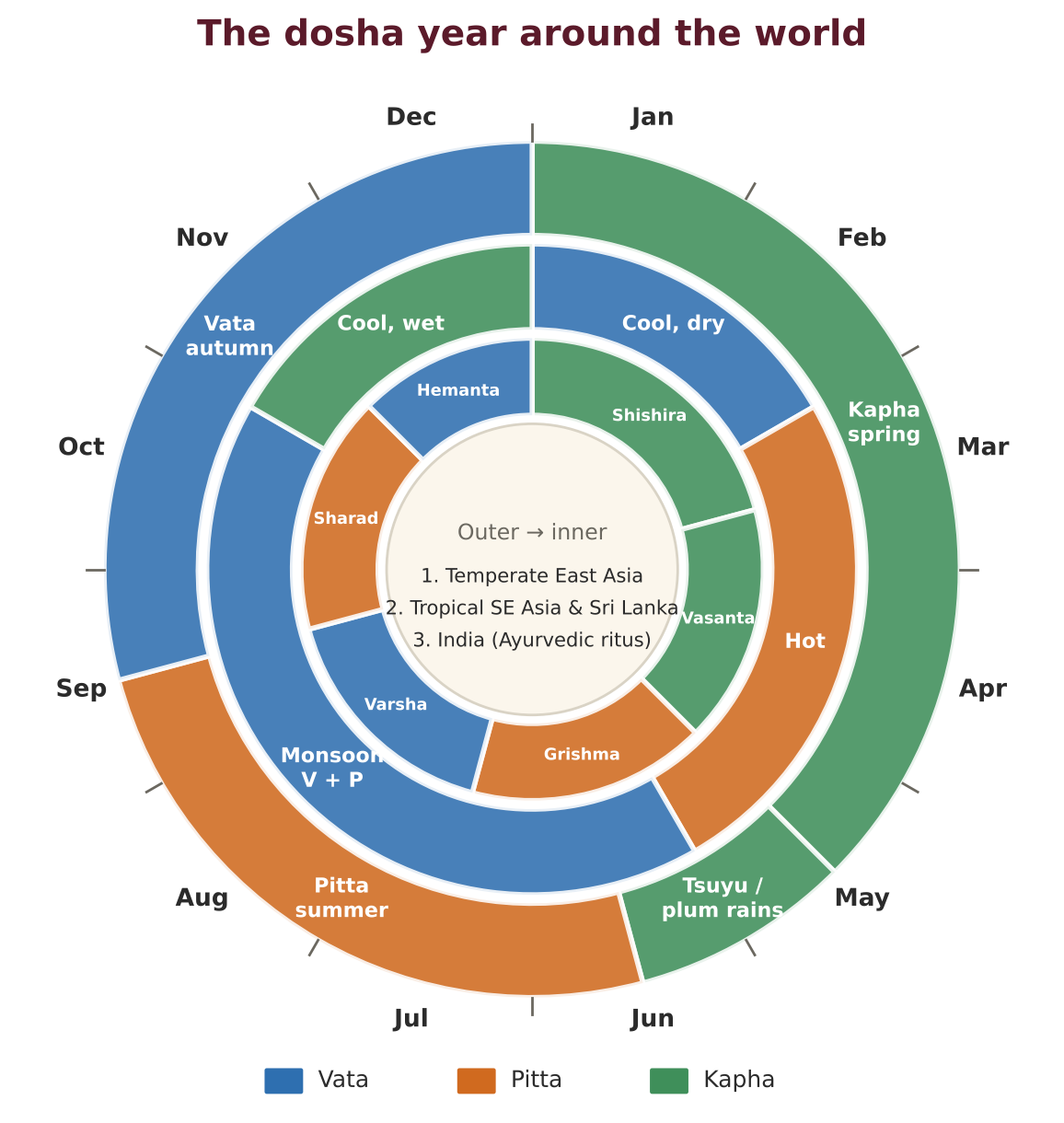 Figure — The dosha year in temperate East Asia (outer ring), tropical Southeast Asia and Sri Lanka (middle) and the Indian ritu calendar (inner).
| Region | Climate pattern | Dosha calendar | Kitchen emphasis |
|---|---|---|---|
| North China, Korea, northern Japan | Very cold dry winter, hot humid summer, short springs and autumns | Vata late autumn–winter; Kapha late winter–spring; Pitta summer | Thick soups, noodle soups, dumplings in winter; mung, winter melon and barley tea in summer |
| South China, Taiwan, southern Japan | Mild winter, long hot humid summer, plum rains (tsuyu, meiyu) in June | Kapha in the damp rainy season; Pitta in summer | Ginger, light broths, barley, adzuki to counter dampness; cooling soups in summer |
| Himalaya, Tibet, Bhutan | Cold, dry, windy, high altitude | Vata most of the year | Ghee, barley, thukpa, momos, warm milk and butter |
| Mainland Southeast Asia | Hot dry season (Mar–May), monsoon (May–Oct), cool dry season (Nov–Feb) | Pitta in the hot season; Vata + Pitta in the monsoon; mild Kapha/Vata in the cool season | Coconut, rice, mung; ginger and lemongrass in the monsoon |
| Equatorial Malaysia, Indonesia, Singapore | Hot and humid all year, monsoon rains | Pitta–Kapha all year | Light, cooked, mildly spiced food; coconut used moderately; avoid heavy fried food |
| Sri Lanka | Two monsoons; hot coastal plains, cool hills | Pitta–Kapha in the lowlands; Vata–Kapha in the hills | Red rice, kola kanda, gotu kola, coconut, mild curries |
The 24 solar terms and the doshas
East Asian farmers and cooks divide the year into 24 solar terms (jiéqì in Chinese, sekki in Japanese, jeolgi in Korean), each about 15 days long. They map neatly onto Ayurveda's six ritus, each of which spans four solar terms.
| Ayurvedic ritu (approx. dates) | Solar terms (Chinese / Japanese) | Dosha | Eastern kitchen guidance |
|---|---|---|---|
| Shishira — late winter (mid-Jan – mid-Mar) | Xiǎohán / Shōkan (Minor Cold) · Dàhán / Daikan (Major Cold) · Lìchūn / Risshun (Start of Spring) · Yǔshuǐ / Usui (Rain Water) | Kapha accumulates | Warming congees, ginger and jujube tea, Lunar New Year food in moderation; nanakusa-gayu on 7 January |
| Vasanta — spring (mid-Mar – mid-May) | Jīngzhé / Keichitsu (Awakening of Insects) · Chūnfēn / Shunbun (Spring Equinox) · Qīngmíng / Seimei (Clear and Bright) · Gǔyǔ / Kokuu (Grain Rain) | Kapha aggravated | Spring greens, buckwheat soba, daikon, sprouts; less sticky rice and sweets |
| Grishma — early summer (mid-May – mid-Jul) | Lìxià / Rikka (Start of Summer) · Xiǎomǎn / Shōman (Grain Buds) · Mángzhòng / Bōshu (Grain in Ear) · Xiàzhì / Geshi (Summer Solstice) | Pitta accumulates; Vata begins to rise | Mung, winter melon, cucumber, barley tea at room temperature; plum-rain foods with ginger |
| Varsha — rains / high summer (mid-Jul – mid-Sep) | Xiǎoshǔ / Shōsho (Minor Heat) · Dàshǔ / Taisho (Major Heat) · Lìqiū / Risshū (Start of Autumn) · Chǔshǔ / Shosho (End of Heat) | Vata aggravated, Pitta accumulating | Cooked food only, ginger, light congees, mung-bean soup |
| Sharad — autumn (mid-Sep – mid-Nov) | Báilù / Hakuro (White Dew) · Qiūfēn / Shūbun (Autumn Equinox) · Hánlù / Kanro (Cold Dew) · Shuāngjiàng / Sōkō (Frost's Descent) | Pitta aggravated | Pears, persimmons, lotus root, sesame, rice; Mid-Autumn Festival |
| Hemanta — early winter (mid-Nov – mid-Jan) | Lìdōng / Rittō (Start of Winter) · Xiǎoxuě / Shōsetsu (Minor Snow) · Dàxuě / Taisetsu (Major Snow) · Dōngzhì / Tōji (Winter Solstice) | Agni strongest; Kapha begins | Nourishing soups, adzuki, sesame, tang yuan at Dongzhi, root vegetables |
[!WARNING] The monsoon kitchen
- Ayurveda treats the rainy season (Varsha) as the most dangerous for digestion: agni is weak, water may be contaminated, and all three doshas are disturbed.
- Across monsoon Asia, the same wisdom appears: boil all water, eat freshly cooked food, add ginger to everything, and favour thin rice porridges and clear soups.
- In this season choose the congees (Section 1), clear soups (Section 2), steamed dishes (Section 3) and ginger teas (Section 11); avoid raw salads, rice-paper rolls with raw herbs, and cold desserts.