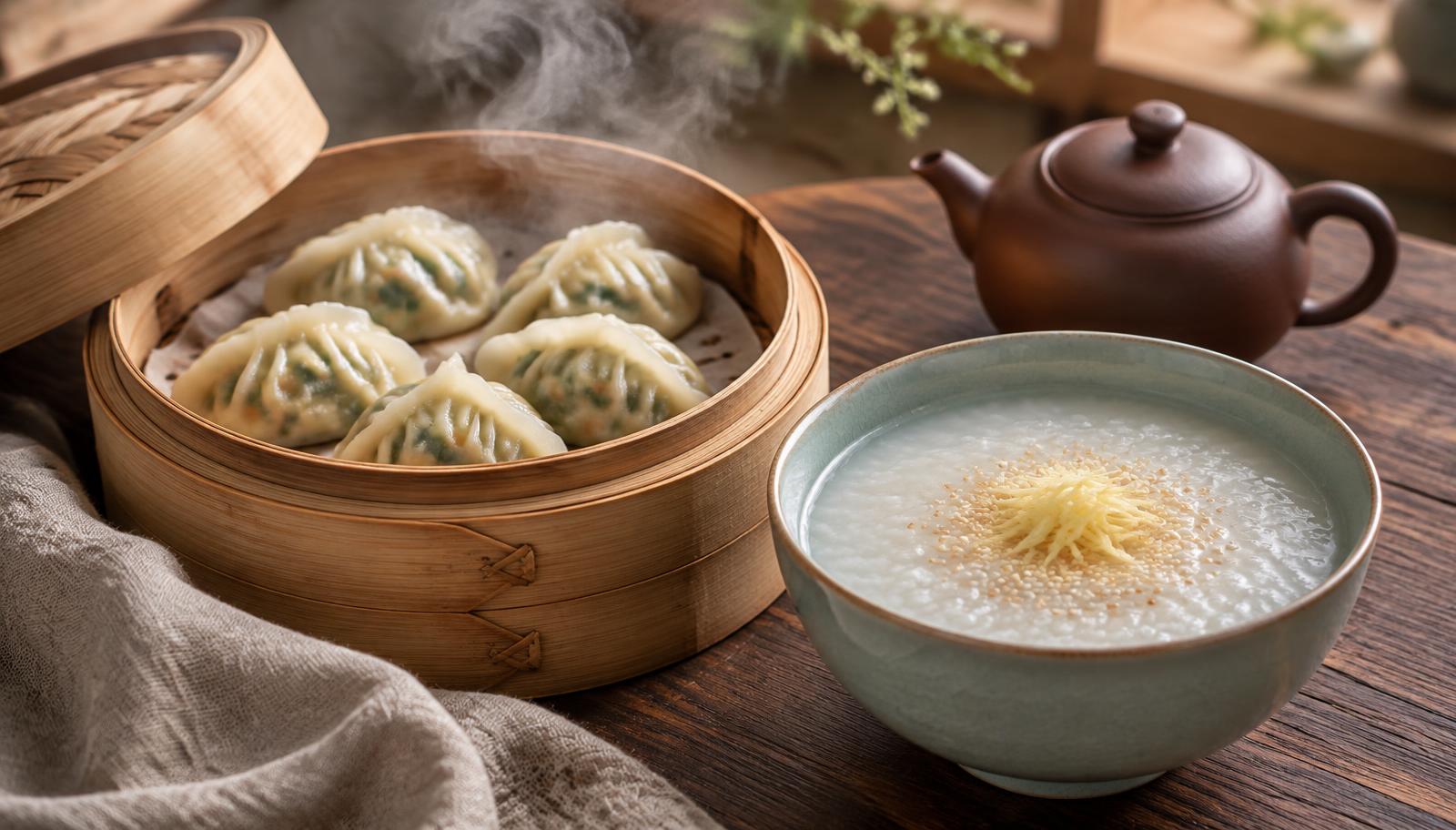
Readers who know Chinese medicine or Japanese temple cooking will find much that is familiar in Ayurveda. The comparison below is offered as a bridge, not an equation: each system has its own logic and should be learned on its own terms. Modern science has tested few of the traditional classifications of foods as heating or cooling [10].
| Concept | Ayurveda | Chinese medicine (TCM) | Notes for the cook |
|---|---|---|---|
| Basic elements | Five: ether, air, fire, water, earth | Five phases: wood, fire, earth, metal, water | Different lists; both describe qualities in nature and body |
| Functional principles | Three doshas: Vata, Pitta, Kapha | Yin and yang; qi, blood and fluids | Vata ≈ wind and dryness; Pitta ≈ heat; Kapha ≈ dampness and phlegm |
| Thermal nature of food | Virya: heating (ushna) or cooling (shita) | Five natures: hot, warm, neutral, cool, cold | Broadly agree: ginger, cinnamon, pepper warm; mung, winter melon, cucumber, chrysanthemum cool |
| Tastes | Six rasas: sweet, sour, salty, pungent, bitter, astringent | Five flavours: sweet, sour, salty, pungent, bitter (plus bland and astringent) | Astringent is a full taste in Ayurveda; TCM groups it with sour |
| Digestion | Agni (digestive fire); ama (undigested residue) | Spleen–stomach qi; dampness | Both advise warm, cooked food and avoiding iced drinks |
| Daily clock | Kapha 6–10, Pitta 10–2, Vata 2–6 (twice daily) | Organ clock: stomach 7–9 am, spleen 9–11 am, etc. | Both favour a substantial breakfast or lunch and a light, early dinner |
| Seasons | Six ritus; ritucharya | Five seasons including late summer; 24 solar terms | Both eat with the season |
| Excess | Kapha: heaviness, mucus, sluggishness | Dampness: heaviness, phlegm, poor appetite | Both use barley, adzuki, ginger and light grains to clear it |
Shōjin ryōri: the Zen kitchen#
Shōjin ryōri — literally "devotion cuisine" — is the vegetarian food of Japan's Zen temples, brought from China by monks such as Dōgen in the 13th century. It is organised by a set of "fives" that echo Ayurveda's attention to variety and balance [4]:
| Principle | Japanese | What it means | Ayurvedic parallel |
|---|---|---|---|
| Five colours (goshiki) | White, black, red, yellow, green | Every meal shows all five colours | Varied vegetables supply the six tastes and many qualities |
| Five flavours (gomi) | Sweet, sour, salty, hot, bitter (+ delicate, awai) | Every meal touches every flavour | The six rasas on one plate |
| Five methods (gohō) | Raw, simmered, grilled, fried, steamed | Variety of cooking techniques | Varied qualities: light and heavy, moist and dry |
| No gokun | The five pungent vegetables excluded | Onion, garlic, leek, chive and scallion are omitted | Sattvic diet omits onion and garlic |
| Seasonality | Shun | Eat each food at its peak | Ritucharya |
| Mindful preparation | Tenzo | The temple cook cooks as spiritual practice | Annapurna seva — cooking as worship |
The five pungents and the sattvic diet#
Mahayana Buddhist monastics in China, Korea, Vietnam and Japan avoid five pungent plants (wǔ hūn): garlic, onion and shallot, leek, chive or Chinese onion, and — in some lists — asafoetida [3]. Their reason is close to the yogic one: the pungents are said to excite the passions and disturb meditation. The Annapurna Kitchen follows the same rule for onion and garlic.