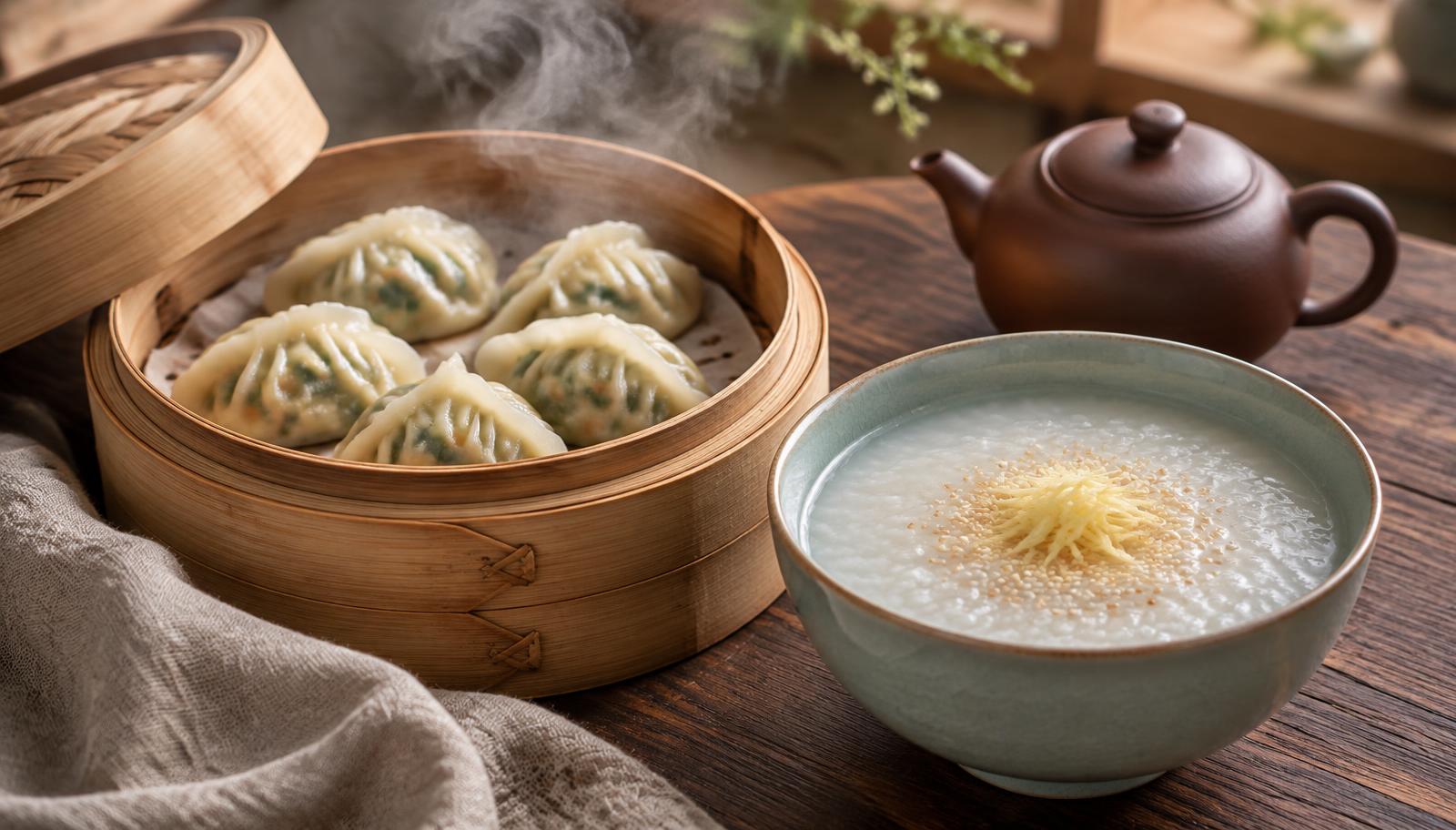
Long before the words "fusion cooking" were coined, the kitchens of Asia were talking to one another. Buddhist monks carried Indian ideas about food, purity and medicine across the Himalaya to Tibet, along the Silk Road to China, and onwards to Korea and Japan. Traders and teachers carried them by sea to Sri Lanka, Burma, Thailand and the Indonesian archipelago. Each culture absorbed what it met into its own medical and culinary traditions — so that today a bowl of Japanese okayu, a Korean pumpkin juk and a Kerala rice kanji are recognisably the same healing food.
This volume brings these kitchens back into conversation with Ayurveda. It is written for guests of the Annapurna Kitchen from East and Southeast Asia, for Indian readers who love Chinese, Japanese or Thai food, and for older readers anywhere who find the light, steamed, broth-based food of Asia comforting and easy to digest. Every recipe keeps the sattvic rules of Shree Shree Ma Anandamayee International Centre: no onion, garlic, meat, fish, eggs, mushrooms or alcohol. Fish sauce, oyster sauce, shrimp paste and bonito are replaced with soy, kombu and jaggery; scallion and garlic with ginger, coriander, lemongrass and galangal.
The traditions in this book#
| Tradition | Region | Relationship to Ayurveda | What it brings to the kitchen |
|---|---|---|---|
| Sowa Rigpa (Tibetan medicine) | Tibet, Ladakh, Bhutan, Mongolia, Himalayan India | Built on a largely Ayurvedic foundation; its Four Tantras (Gyü Zhi) overlap extensively with the Ashtanga Hridaya, translated into Tibetan by Rinchen Zangpo [8] | The three nyepa (rlung, mkhris-pa, bad-kan = Vata, Pitta, Kapha); butter, barley, warming broths |
| Thai traditional medicine | Thailand, Laos, Cambodia | Reveres Jivaka Komarabhacca, the physician of the Buddha, as its father; shares elemental theory with Ayurveda [9] | Herbal tonics, lemongrass, galangal, coconut, balance of flavours |
| Sri Lankan Deshiya Chikitsa and Ayurveda | Sri Lanka | Ayurveda practised alongside indigenous medicine for over two millennia | Kola kanda (herbal porridge), gotu kola, coconut, red rice |
| Chinese medicine (TCM) | China, Taiwan, Hong Kong, diaspora | An independent system with striking parallels: hot/cold natures, five flavours, food as medicine [10] | Congee, tonic soups, ginger, red dates, goji, warming and cooling foods |
| Kampo and shōjin ryōri | Japan | Kampo derives from Chinese medicine; shōjin ryōri is the vegetarian cuisine of Zen temples [4] | Kombu dashi, seasonal vegetables, five colours and flavours, mindful eating |
| Korean temple cuisine and hansik | Korea | Buddhist temple food omits the five pungent vegetables; hansik emphasises balance of yin–yang and five colours [3] | Juk (porridges), namul, fermented bean pastes |
| Jamu and Malay traditional medicine | Indonesia, Malaysia | Influenced by Indian Ayurveda, Arab and Chinese medicine | Turmeric, ginger, galangal, tamarind tonics |
What travels — and what is different#
Where the systems differ is mostly in their vocabulary and in a few foods. Chinese medicine speaks of yin and yang, qi, dampness and five organ networks; Ayurveda speaks of doshas, agni, ama and seven tissues. Japanese and Chinese kitchens rely heavily on soy foods and fermented seasonings, which Ayurveda treats with caution because of their salt and heaviness. Raw fish and alliums are central to many Asian cuisines and absent here. Chapter 3 maps the vocabularies side by side.
Why Eastern food suits people over fifty#
East Asian home cooking is, in many ways, an ideal elder diet: a bowl of rice or congee, a warm soup, small portions of several cooked vegetables, a little tofu or beans, and tea. Japan and Korea have among the highest life expectancies in the world, and the traditional diet of Okinawa — dominated by sweet potato, vegetables and soy, eaten in moderate amounts — is often cited in research on healthy ageing [11]. The same cuisines carry one significant risk: salt, from soy sauce, miso, pickles and broths. Chapter 7 shows how to keep the benefits while halving the salt.