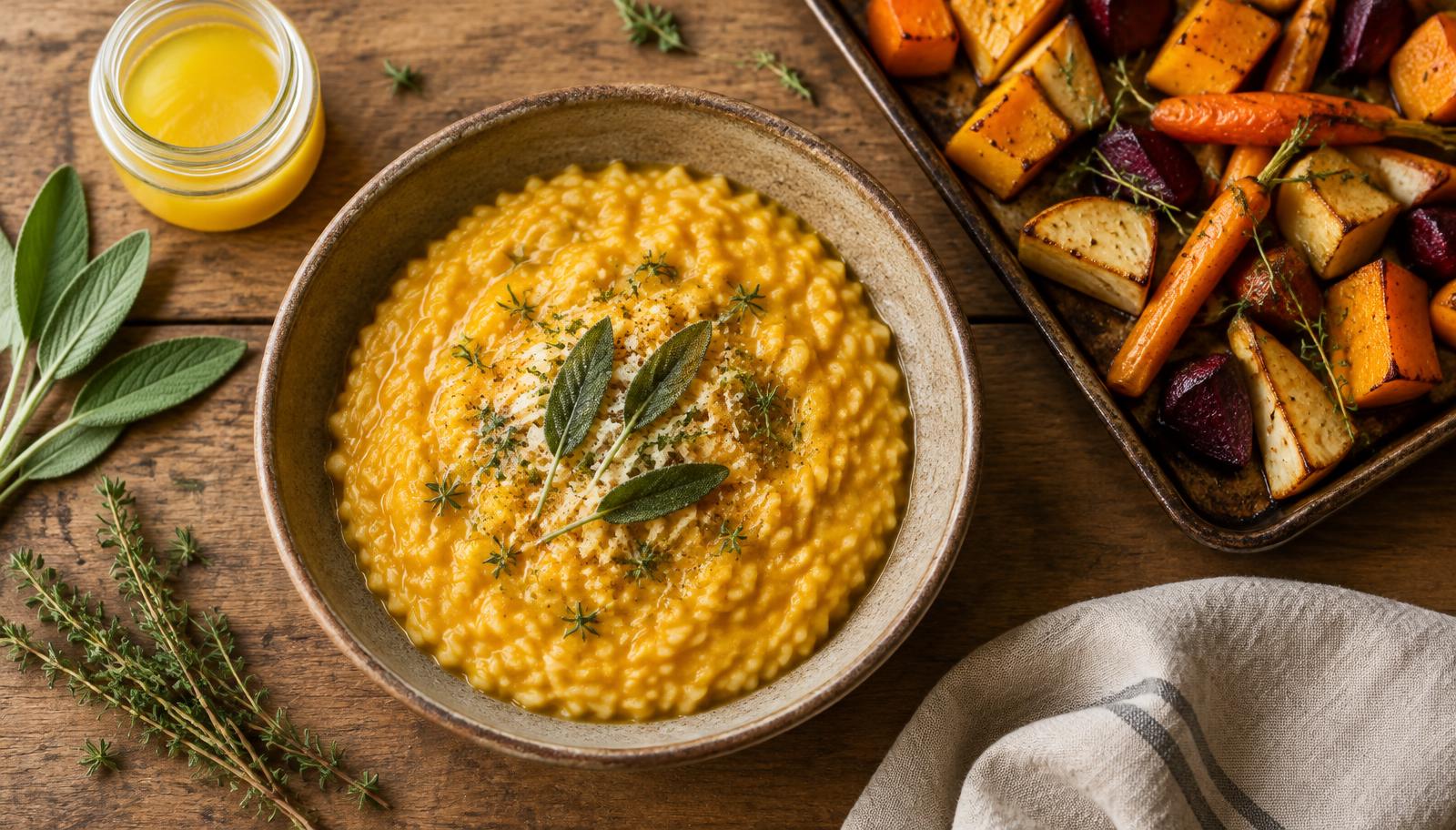
Ayurveda was never a list of Indian dishes. It is a way of reading food — by its qualities, its tastes, its effect after digestion, and its fit with the person, the season and the hour. Those principles were worked out on the plains of north India and the coast of Kerala, but they apply as well to a kitchen in Lyon, Leeds, Toronto or Melbourne. A pear is sweet and cooling whether it grows in Himachal or in Oregon; a bowl of hot oats grounds a nervous, chilly morning in Edinburgh exactly as it does in Haridwar.
This volume is written for the many guests of the Annapurna Kitchen who come from Europe, the Americas and Australasia, for the Indian families living abroad who cook with what the local market sells, and for readers aged fifty and over everywhere who want the comfort of familiar Western dishes without giving up the wisdom of Ayurveda. Every recipe keeps the sattvic rules of Shree Shree Ma Anandamayee International Centre: no onion, garlic, meat, fish, eggs, mushrooms or alcohol. Where a Western classic depends on one of these, we show the swap and explain why it works.
What travels — and what does not#
What does not travel unchanged is the calendar. India's six ritus (Shishira, Vasanta, Grishma, Varsha, Sharad, Hemanta) are tied to the monsoon. A northern European autumn is cold, dry and windy — classic Vata weather — while a Mediterranean summer is hot and dry, and a Pacific North-West winter is cold and wet, which is Kapha. Chapter 2 translates the dosha calendar for temperate climates and the southern hemisphere.
Rasa, virya and vipaka in one table#
Every food in this book is understood through three lenses: its taste on the tongue (rasa), its heating or cooling potency (virya), and its post-digestive effect (vipaka). The table shows how familiar Western ingredients fit.
| Taste | Elements | Effect on doshas | Western examples in this book |
|---|---|---|---|
| Sweet (madhura) | Earth + water | Calms Vata and Pitta; increases Kapha | Oats, wheat, rice, sweet potato, squash, dates, maple, milk, ricotta |
| Sour (amla) | Earth + fire | Calms Vata; increases Pitta and Kapha | Lemon, apple-cider vinegar, plums, berries, tomato, yoghurt |
| Salty (lavana) | Water + fire | Calms Vata; increases Pitta and Kapha | Sea salt, olives, feta, Parmesan, vegetable stock |
| Pungent (katu) | Fire + air | Calms Kapha; increases Vata and Pitta | Black pepper, ginger, mustard, rocket, radish, oregano, thyme |
| Bitter (tikta) | Air + ether | Calms Pitta and Kapha; increases Vata | Kale, chard, chicory, dandelion, artichoke, fenugreek |
| Astringent (kashaya) | Air + earth | Calms Pitta and Kapha; increases Vata | Lentils, split peas, chickpeas, pomegranate, apple, quinoa |
A balanced Western meal can include all six without effort: a lentil soup (astringent, sweet), a slice of spelt bread with ghee (sweet), a green salad of cooked chard with lemon (bitter, sour), a pinch of pepper (pungent) and salt.
Twenty qualities, Western style#
The gunas give the simplest rule of all — like increases like, opposites balance. Cold, dry, light, rough foods (crackers, raw salad, iced drinks, popcorn) increase Vata; hot, sharp, oily foods (chilli, fried food, aged cheese, coffee, alcohol) increase Pitta; heavy, cold, oily, sweet foods (ice cream, cheesecake, white bread, fried potatoes) increase Kapha. The same hot–cold logic appears in Chinese medicine's classification of warming and cooling foods [12].
| Pair of qualities | Western foods with the first quality | Western foods with the second |
|---|---|---|
| Heavy / light | Cheese, pasta, bread, nuts, avocado | Quinoa, millet, rice cakes, broth, steamed greens |
| Hot / cold | Ginger, pepper, mustard, coffee, oregano | Cucumber, mint, milk, coconut, iced drinks |
| Oily / dry | Olive oil, butter, avocado, nuts | Crackers, rye crispbread, popcorn, dried beans |
| Smooth / rough | Puréed soup, custard, ripe pear | Raw cabbage, granola, dried fruit, raw kale |
| Dense / liquid | Fudge, cheese, dense bread | Soups, stews, porridges, teas |
| Stable / mobile | Root vegetables, grains, ghee | Caffeine, sugar, raw sprouts, carbonated drinks |
Why these recipes suit people over fifty#
From about the sixth decade, Ayurveda describes life as entering its Vata phase: the body becomes drier, lighter and more irregular; digestion becomes more variable; sleep lighter; joints stiffer. Modern geriatrics describes the same changes in its own language — lower appetite and thirst, reduced stomach acid and B12 absorption, slower bowel transit, loss of muscle (sarcopenia), and a greater need for protein, calcium and vitamin D [7] [8].
The recipes in this volume answer both languages:
- They are warm, moist and soft — Vata-pacifying, and easier to chew and swallow.
- They include protein at most meals (legumes, ricotta, cottage cheese, paneer, nuts, quinoa) to protect muscle.
- They keep salt moderate (most dishes below 1.5 g per portion) and use herbs, lemon and spice instead.
- Each recipe gives a Care note for 55+ guests: texture adjustments, protein, salt and medication cautions.